
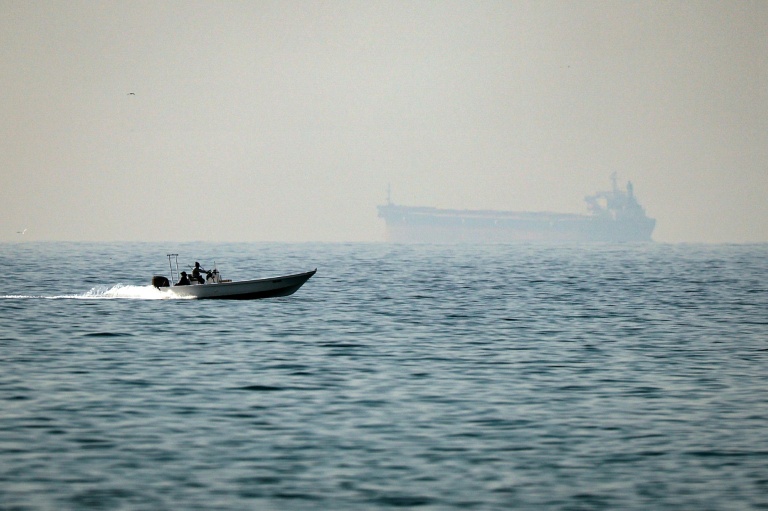
Paris (France) (AFP) – The United States and France have promised to secure oil shipping threatened by the Middle East war, but experts warn that warship availability and Iran’s wide range of weaponry could complicate this effort. US-Israeli attacks on Iran since Saturday, along with Iran’s fiery response, have caused global economic turmoil as shipping avoids the Strait of Hormuz, one of the world’s most vital shipping lanes. Around a fifth of the world’s crude and liquefied natural gas from the Gulf must pass through this chokepoint.
While Iran has not officially shut off the Strait of Hormuz, shipping through the waterway has all but dried up. President Donald Trump stated on Tuesday that the US Navy was ready to escort oil tankers through the crucial Gulf shipping route to ensure the “FREE FLOW of ENERGY to the WORLD.” France’s President Emmanuel Macron expressed earlier the same day that France was building a coalition “to pool the necessary resources, including military ones, so that traffic can be restored and secured” in the Strait of Hormuz, Suez Canal, and Red Sea.
However, analyst Dirk Siebels from consultancy firm Risk Intelligence noted that “the practical realities of this potential operation would be very challenging.” Kais Makhlouf, also from Risk Intelligence, highlighted a significant obstacle, saying “military assets are busy right now doing military stuff,” which limits the number of forces available to escort oil and LNG tankers. US-Israeli air strikes have targeted Iran, while a US submarine recently torpedoed an Iranian warship off the coast of Sri Lanka, resulting in at least 86 crew member deaths.
A European military source, speaking on condition of anonymity, indicated that Iran still posed a threat to shipping, as it could deploy missiles, air or underwater drones, or midget submarines, and even scatter floating or magnetic mines that detonate upon proximity to a ship. Western nations aiming to secure the route for maritime traffic might consider frigate patrols or specific ship escorts, potentially with additional air cover. “If the strait was mined, this would require minehunters preceding convoys, or establishing safe corridors before commercial vessels could transit,” the source elaborated.
Excluding any potential mining threats, the scenario would mirror that in the Red Sea, where US and European navies have been protecting ships from attacks by Iran-backed Yemeni rebels.
Several sources suggested that any coalition in the Hormuz Strait could take inspiration from the EU operation that has been working with the Yemeni navy in the Red Sea since February 2024. French Foreign Minister Jean-Noel Barrot mentioned that the aim was to secure the Hormuz Strait in “the same spirit” as the European Union’s Operation ASPIDES naval task force. Although wary of direct involvement in the US-Israeli war with Iran, European countries are being drawn in due to attacks on Cyprus and Western allies in the Gulf.
France, Greece, and Italy have announced the dispatch of warships to the eastern Mediterranean, where the Suez Canal provides passage to the Red Sea and beyond to the Gulf. A French diplomatic source, wishing to remain anonymous, indicated that discussions were ongoing to bolster the EU ASPIDES operation. “As for Hormuz, we need to see how things develop,” the source added.
“The gradual build-up of the European naval presence in the eastern Mediterranean will eventually prove useful if and when conditions are met to move into the Strait of Hormuz,” they stated. Alessio Patalano, a professor at King’s College London, emphasized the importance of collaborative action, saying, “for the Europeans, it is essential to act as a coalition because very few European navies have the capabilities required to confront these threats like the British, French, or Italian.”
© 2024 AFP