
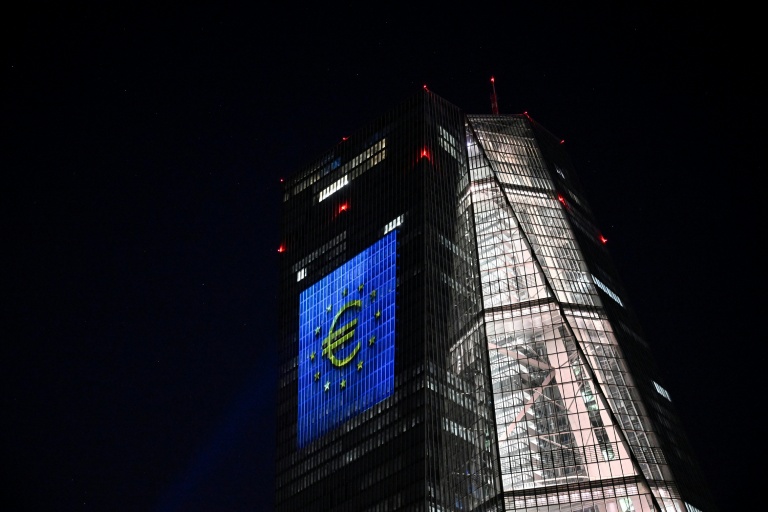
Frankfurt (Germany) (AFP) – The European Central Bank warned Thursday that the energy shock unleashed by the Middle East war would sharply push up inflation and hit the eurozone’s growth this year. The ECB kept borrowing costs on hold as expected, but President Christine Lagarde dropped typical language that rates were in a “good place,” and analysts raised their bets on hikes at forthcoming meetings.
From the United States to Britain and Japan, major central banks have all taken a cautious approach at meetings in recent days, keeping interest rates on hold even as worries grow about higher oil and gas prices pushing up inflation. But Lagarde issued a stark warning that the world was undergoing a “severe shock” due to the war, pitting the United States and Israel against Iran, saying it had “made the outlook significantly more uncertain.” The conflict was a “risk to the euro area economy,” potentially weighing on growth and pushing up inflation, she said.
“A prolonged war could increase energy prices further and for longer than currently expected and also weigh on confidence,” she said. New ECB projections forecast that eurozone inflation would come in at 2.6 percent over this year—above the Frankfurt-based institution’s two-percent target, and higher than a pre-war forecast in December of 1.9 percent. It also cut its 2026 growth forecast to 0.9 percent from 1.2 percent in December. In a more extreme scenario, where oil prices surge higher than currently expected, the ECB warned 2026 growth could fall as low as 0.4 percent and inflation might come in at 4.4 percent over 2026. Lagarde, however, repeatedly insisted the ECB was “well positioned” to deal with the unfolding shock.
The decision to hold rates for now was unanimous, she said, adding that the ECB’s rate-setting governing council was “laser-focused” on dealing with the war’s economic fallout.
**Hikes on the cards?**
Higher inflation would typically lead to rate hikes, but with the war just three weeks in and amid great uncertainty about how long it will last, Lagarde remained tight-lipped on future decisions. Capital Economics, however, said the ECB’s language indicated chances of a hike had risen. “If energy prices keep rising, we suspect that the balance of opinion will shift towards getting on the front foot by hiking at the next meeting at the end of April,” said Jack Allen-Reynolds, the group’s deputy chief eurozone economist.
The 21-nation euro area is heavily dependent on energy imports, leaving it vulnerable to the fallout from the war. Oil and gas prices surged anew Thursday after Iran hit the world’s largest liquefied natural gas (LNG) facility in Qatar, following a strike on its own gas field. The Strait of Hormuz, a crucial route for global energy exports, has also been almost entirely blocked to oil and gas tankers since the war began.
The expected jump in inflation will weigh on eurozone households and businesses while the growth slowdown could leave the region even further behind rivals the United States and China. For now, higher energy costs are yet to show up in the latest inflation data, which covers the pre-war period. The official eurozone inflation rate for February was 1.9 percent. The eurozone’s benchmark interest rate has been at two percent since June.
Other major central banks meeting this week have taken a similar approach, and all kept rates on hold. The US Federal Reserve has, however, raised its inflation outlook citing the “uncertain” situation, the Bank of Japan warned higher energy prices would stoke inflation, and the Bank of England said household energy bills could increase.
For Europe, the war has rekindled memories of the energy shock that followed Russia’s 2022 invasion of Ukraine. At that time, the ECB was criticised for moving too slowly to hike rates and tame red-hot prices, but Lagarde insisted Thursday the backdrop now was not the same. Before the Ukraine war started, inflation had already been elevated due to pandemic supply chain problems and labour shortages, whereas now it was below the ECB’s target, she said.
With European governments scrambling to provide relief to citizens set to be hit by higher energy costs, Lagarde warned them not to go over the top. “Any fiscal responses to the energy price shock should be temporary, targeted and tailored,” she stressed.
burs-sr/vbw/cw
© 2024 AFP