
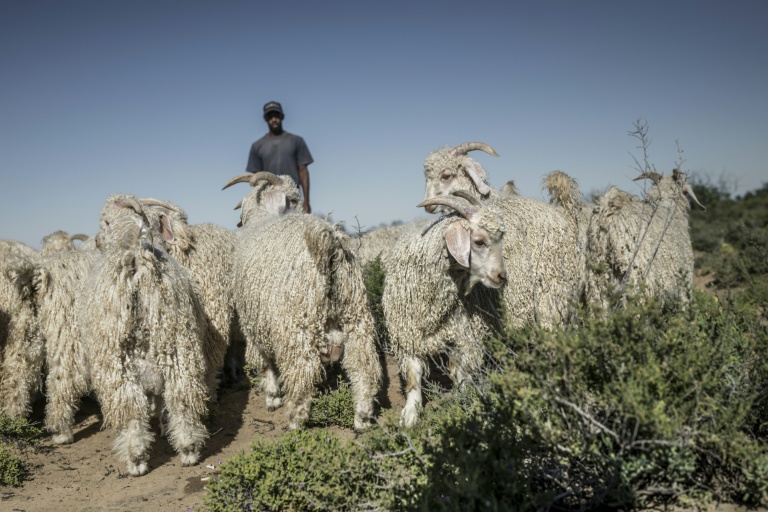
Graaff-Reinet (South Africa) (AFP) – On a farm in South Africa’s semi-arid south, herds of angora goats foraged across open land stretching to the horizon, their pale fleeces glinting in the harsh sun. Linked by dirt tracks and dotted with remote farms, the sparsely populated Karoo region sits at the heart of the global mohair trade, supplying more than half of the world’s output of the fibre prized for its sheen and softness. A Cape Dutch-style gable in one corner of the farm bears the inscription “Wheatlands 1912.”
“This is the newest house on the property,” said Lloyd Short, who grew up on the 7,700-hectare (19,000-acre) family farm. But Wheatlands owes its reputation not to architecture or rural charm, but to its goats with drooping ears, curved horns and lustrous golden fleeces. Their silky curls can fetch up to 900 rands ($53) per kilogramme and are used in knitwear, often blended with wool. The Italian mill Vitale Barberis Canonico, renowned for luxury suit fabrics, is among those sourcing South African mohair for their yarn.
“The first two shearing are the most valuable,” said Short, a seventh-generation farmer, who collects an average of between one and 1.5 kilogrammes per animal. Output rises slightly with age, but the fibre loses value over time. Short and his brother each have around 2,000 goats and supply a major French fashion house exclusively, allowing it to trace its sourcing and protect its brand.
The industry’s reputation was tested in 2018, when animal rights organisation People for the Ethical Treatment of Animals (PETA) released footage of a goat killed after an artery was accidentally cut during shearing — an incident farmers say is rare. Brands, including Swedish H&M, American Gap, Zara and Topshop, swiftly dropped mohair. Confidence only began to recover after the introduction of an independently audited animal welfare certification. “Farmers go through annual audits, so they get visited once a year by their brokers and then they also get third-party audited,” said Marco Coetzee, director of the sector’s representative organisation, Mohair South Africa.
South Africa accounted for 56 percent of global production in 2024, according to industry figures. The sector supports around 30,000 jobs, including hundreds in the Karoo, an unlikely new home for a breed originally from Turkey. How the goats arrived in the 19th century remains unclear. Accounts differ whether they were a gift from an Ottoman dignitary or imported by a British officer. More than one and a half centuries later, angoras thrive on the region’s succulent plants.
“It’s an incredibly healthy area, there are wonderful veld species, sweet plants. Almost everything is palatable,” said Sean Hobson, whose family has raised angoras on his farm since 1865. More humid regions are less suitable due to parasites and ticks, he explained. To protect the animals, farmers dip them between the twice-yearly shearings, followed by a conditioning rinse to help the fibres form their distinctive curl.
“The world buys mohair, firstly because of the lustre,” said Pierre van der Vyver, chief executive of broker House of Fibre, adding it “is very strong, doesn’t break or shrink.” The smell of a shearing shed hangs in the air at his warehouse near the port city of Gqeberha, formerly known as Port Elizabeth, where hundreds of bales await shipment. Alongside South African rival OVK, the company controls more than 70 percent of global supply, with neighbouring Lesotho accounting for another 16 percent. Almost all buyers, except Vitale Barberis Canonico, purchase mohair in bales.
Processing is dominated by two South African firms, Samil and Stucken, which also handle fibres from Australia and the United Kingdom. “The Chinese want to compete with us, but fortunately, there is a lot of technique involved in mohair processing,” said van der Vyver. “It’s a far slower process than for wool processing. It is a specialised fibre.”
© 2024 AFP