
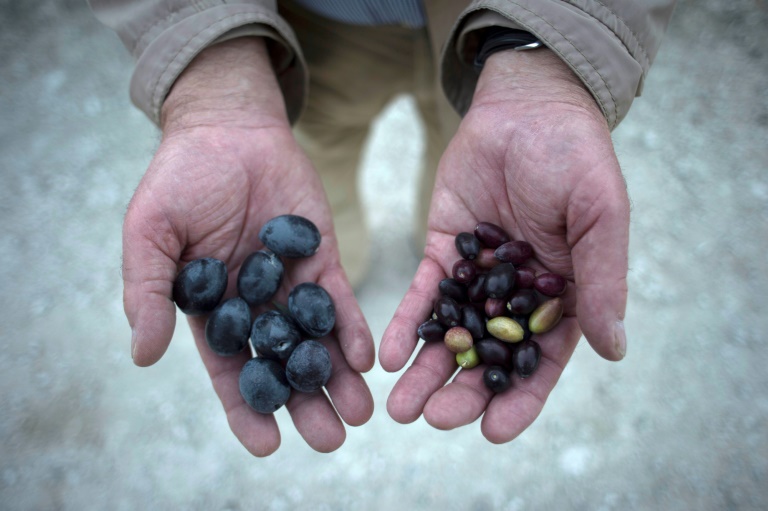
Madrid (AFP) – Olive oil producers are improving irrigation and seeking new varieties of olives to safeguard production as climate change upends harvests, causing prices of the staple of the Mediterranean diet to soar.
“Climate change is already a reality and we need to adapt to it,” according to the executive director of the International Olive Council (IOC) Jaime Lillo.
He spoke at the opening of the three-day olive oil congress in Madrid which brings together 300 participants from around the globe.
The gathering came as the world’s top olive oil producers, including Spain, Italy and Greece, have recorded an unprecedented drop in production over the past two years due to extreme drought and repeated heatwaves.
Global production of olive oil fell from 3.42 million tonnes in the 2021-2022 season to 2.57 million tonnes in 2022-2023, IOC figures show.
And according to data supplied by the organisation’s 37 member states, it is set to fall again in 2023-2024 to 2.41 million tonnes.
This has caused prices to soar by between 50 percent and 70 percent over the past year, depending on the variety concerned. Prices in Spain, which supplies around half of the world’s olive oil, have tripled since 2021, to the dismay of consumers.
– ‘Complex scenarios’ –
Olive oil has been an essential part of the Mediterranean diet for thousands of years. Spaniards for instance use it to cook and to season fish, salads, vegetables and other dishes.
“The rise in prices has been a particularly demanding stress test for our sector. We have never experienced anything like this before,” said Pedro Barato, the head of the Spanish Olive oil Interprofessional Organisation.
“We have to prepare ourselves for increasingly complex scenarios that will allow us to face up to the climate crisis,” he added, likening the “turbulence” faced by olive producers to that experienced by the banking sector during the 2008 financial crisis.
The outlook is not encouraging. Over 90 percent of the world’s olive oil production comes from the Mediterranean basin. The United Nations Intergovernmental Panel on Climate Change (IPCC) has said this region is warming 20-percent faster than the global average. This situation could affect world production in the long term.
“We are facing a delicate situation” which implies “changing the way we treat trees and soil”, said Georgios Koubouris, a researcher at the Greek Olive Institute.
“The olive tree is one of the plants best adapted to a dry climate. But in an extreme drought, it activates mechanisms to protect itself and no longer produce anything. To grow olives, you need a minimum amount of water,” said Lillo.
– ‘Find solutions’ –
Among the possible solutions raised at the Madrid congress is genetic research. In recent years hundreds of varieties of olive trees have been tested to identify the species best adapted to higher temperatures.
The goal is to find “varieties that need fewer hours of cold in winter and that are more resistant to stress caused by lack of water at certain key times” of the year, such as spring, said Juan Antonio Polo, head of technology at the IOC.
The sector is also looking to improve water use by storing rainwater, recycling wastewater and employing technology to use less water to irrigate trees.
This means abandoning “surface irrigation” and instead using “drip systems” which bring water “directly to the roots of the trees” to avoid water loss, said Kostas Chartzoulakis of the Greek Olive Institute.
Farmers are abandoning production in certain areas that could become unsuitable for olive trees because they are too dry and moving it to other regions.
There has been a rise in new olive tree plantations, although on a small scale, in regions previously not used to grow the crop, said Lillo, adding that he was “optimistic” about the future.
“With international cooperation, we will gradually find solutions,” he said.
© 2024 AFP