
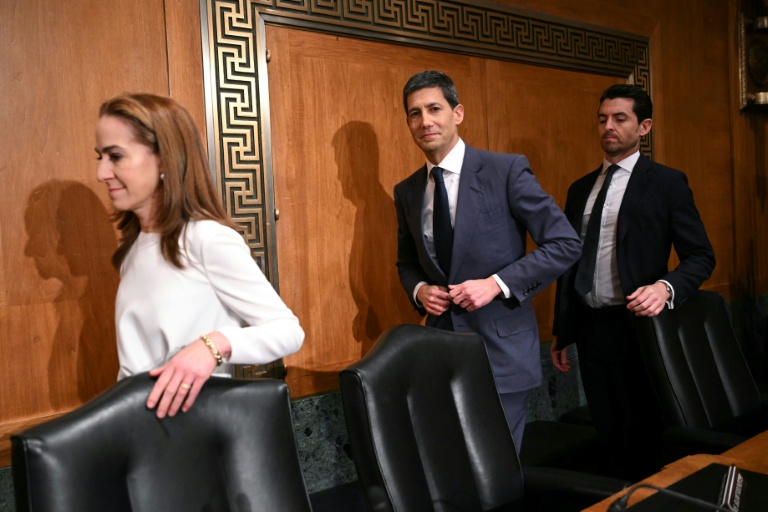
Washington (United States) (AFP) – Kevin Warsh, Donald Trump’s choice to lead the US central bank, was once an inflation foe but has since made the case that interest rates could be lower — an outcome the president has pushed for. Trump announced in January that Warsh, 56, was his choice to succeed Federal Reserve Chair Jerome Powell. But his pick came after months of personal attacks on Powell, whom he repeatedly slammed as a “moron” for not slashing rates more quickly. This fueled widespread fears among investors that the Fed’s cherished policy independence is under threat, potentially posing an inflation risk to the world’s biggest economy.
At his confirmation hearing before the Senate Banking Committee on Tuesday, Warsh repeatedly vowed to act independently if confirmed to the job. Nonetheless, Democratic lawmakers questioned his changing views on inflation. Warsh edged out three other contenders for the Fed job: Fed Governor Christopher Waller, Rick Rieder of the investment behemoth BlackRock, and Trump’s top economic adviser Kevin Hassett. A Fed governor between 2006 and 2011, Warsh was previously a mergers and acquisitions banker at Morgan Stanley. He later joined former president George W. Bush’s administration, serving as a White House economic policy adviser from 2002 to 2006 before being nominated to the Fed’s Board of Governors.
During his first term, Trump also considered Warsh for the Fed chair position, but eventually chose Powell instead. Powell’s fall from grace was capped when US prosecutors issued subpoenas against him threatening a criminal indictment, an unprecedented move widely seen as an escalation of Trump’s campaign against the central bank. Trump has also sought to oust Fed governor Lisa Cook over allegations of mortgage fraud, a move viewed as another attack on the bank.
No longer a ‘hawk’ – Warsh’s term as a Fed governor saw him work closely with its chief Ben Bernanke on the central bank’s policy responses during the financial crisis that rocked the global economy in 2008. He emerged as a key communications conduit between policymakers and financial markets, even as he became increasingly skeptical of some of the Fed’s actions — including interest rate cuts to help contain the damage. He resigned as a Fed governor in 2011, several years before his term was set to expire in 2018. Back then, he was seen as an inflation “hawk,” a term describing policymakers more inclined to prioritize stable prices and low inflation. This is usually done by favoring tighter monetary policy and higher interest rates.
Since then, Warsh has stepped up criticism of the Fed, endorsing policy positions more aligned with Trump and his administration. He argued in a speech last year that the Fed had strayed from its monetary policy mission into political areas where it lacked expertise. Warsh also claimed that poor policy choices by the Fed were holding back the US economy from growing further. In an interview with Fox Business at the time, he backed interest rate cuts to boost growth, even as Fed officials said they needed to evaluate the potential impact of Trump’s tariffs barrage on inflation.
Warsh, a graduate of Stanford University and Harvard Law School, is married to Jane Lauder, of the family known for the Estee Lauder cosmetics group. Her billionaire father Ronald Lauder is a longtime associate of Trump’s. Warsh’s appointment to the Fed will have to be confirmed by the US Senate, where he will face scrutiny from lawmakers across the political spectrum. Republican Thom Tillis, who sits on the Senate Banking Committee, has vowed to oppose the confirmation of any Fed nominee until the probe against Powell is resolved.
© 2024 AFP