

Paris (France) (AFP) – Brent crude went back over $100 a barrel Thursday for the first time since May, as the conflict in the Middle East intensified. This time, however, the impact on the world economy could be greater given that the conflict shows no sign of ending and reserves have already been partially drawn down.
– Not the first time –
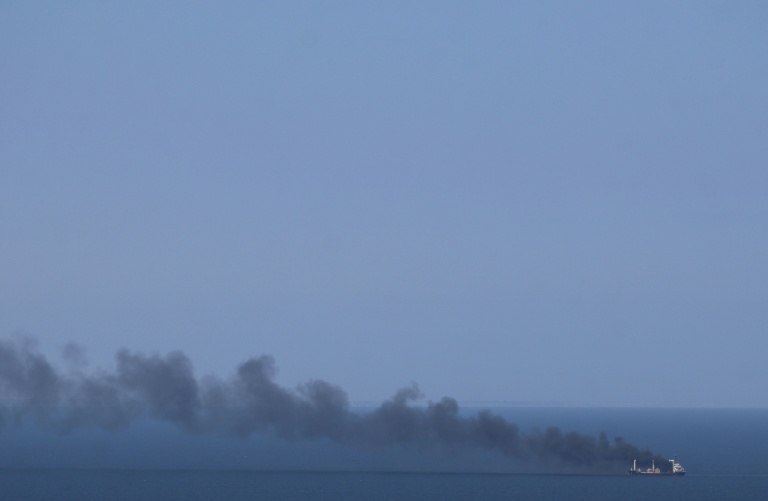
The last time Brent crude—the benchmark international oil contract—broke above $100 a barrel was on March 12 during the first stage of the US-Israeli war on Iran. The last time before that was when Russia launched its invasion of Ukraine in 2022. This latest price surge has been fueled in part by attacks on Saudi tankers in the Red Sea by pro-Iranian Houthi rebel forces in Yemen, which could expand the zone of conflict and potentially cut off the export of millions of barrels of oil.
In normal circumstances, the world economy consumes a little over 100 million barrels of oil daily. In mid-July, the International Energy Agency (IEA) warned that world production was below pre-war levels by around 9.4 million barrels a day.
– Higher stakes –
The threat to the Red Sea raises the stakes. It is the alternative route that Saudi Arabia has been using since the Strait of Hormuz was closed to export its oil. After the war began, it stepped up shipments via pipeline to the Red Sea port of Yanbu, which has allowed it to export some three-quarters of its pre-war level.
“This workaround is now facing headwinds as the blockade and the threat of attacks on ships will make passage through the Red Sea less viable in the near term,” said Maya Senussi of economic advisory firm Oxford Economics. Oxford Economics fears that if both the Red Sea and the Strait of Hormuz were effectively closed to traffic, the price of oil could eventually pass $160 a barrel.
“Much of the world’s spare production capacity has already been used, while strategic and commercial oil inventories are lower than when the war began, leaving the market with fewer buffers against a prolonged supply disruption,” said Janiv Shah, vice president of the Rystad Energy consultancy. That leaves the markets with less room for maneuver, he pointed out.
On Tuesday, the IEA warned that the renewed fighting in the Middle East was increasing concerns over energy supplies.
– Cushioning factors –
But there were still cushioning factors, it added. It cited increased exports from several countries and Saudi and United Arab Emirates oil reaching markets by alternative routes. Producers including Brazil, Kazakhstan, the United States, and Venezuela were increasing their production, and China was trying to cut its imports, it added.
Around 30 IEA countries had more than a billion barrels of oil in reserve. Earlier this month, the Kpler consultancy calculated there was a record 1.35 billion barrels of “oil on water”—product already at sea. That helps limit further crude oil price rises, it argued. The head of French oil giant TotalEnergies was similarly phlegmatic when he announced the company’s second-quarter results Thursday, stating, “We have no problem with stocks to supply our refineries.”
– Risks of an extended conflict –
European Central Bank President Christine Lagarde nevertheless expressed alarm Thursday at the Houthi attack on a Saudi vessel in the Red Sea. The situation in the Red Sea “is clearly going to have an impact and is having an impact,” she said. “We can see that on the price of Brent as it evolves almost by the hour.” Some of the bank’s governors had already suggested a possible rates hike, she added.
Inflationary pressure could encourage central banks to maintain high rates or even raise them. Energy costs, not just of oil but also of gas in winter, impact both production and consumption and have a knock-on effect on economic growth.
© 2024 AFP