
Oliva Gessi (Italy) (AFP) – Scorching summer temperatures have disrupted life for millions of Europeans, but for winegrowers in Italy and France, who are harvesting their grapes unusually early, the hot weather offers pros as well as cons. In Oltrepo Pavese, a winegrowing region in northern Italy, the harvest was in full swing in the final days of July, a first. The same phenomenon is also affecting winegrowing areas of southern France.
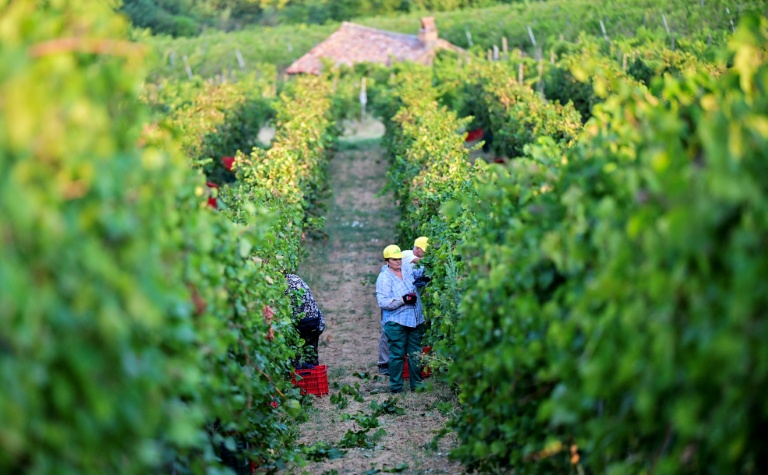
“This year is historic because the grapes have never been harvested in July before,” said Matteo Castellani, head of the Coldiretti farming union for Casteggio, south of Pavia. “We started the harvest at the beginning of the week, on July 27 and 28, and that’s a record.” In Oltrepo Pavese, like elsewhere in general, the harvest usually begins between August 10 and 15,” Castellani told AFP. Under a blazing sun, farm workers delicately detach bunches of Pinot Noir from rows of vines at the Defilippi – I Gessi estate.
“Recent months have seen abnormal heat — a symptom of climate change which, sadly, farmers and the entire sector must now take into account,” said Castellani. Coldiretti forecasts the harvest for Sangiovese grapes, Italy’s most common variety, could begin as early as mid-August in Tuscany. The grapes are usually picked between September and November. For Italy’s top agricultural union, predicting the quality of a harvest that will be spread over almost five months is a real oenological challenge for wineries — not least owing to the concentration of sugars which record temperatures and drought induce in the grapes.
For now, “maturation …is perfect” and “the alcohol content optimal,” said winemaker and estate owner Federico De Filippi, three days into harvesting. But he warned that if the high temperatures continued, they could increase the grapes’ alcohol content, thereby forcing harvesting to be accelerated.
– Acutely arid conditions –
In southern France, months of soaring temperatures have also presaged an early harvest. “A July 30 (start) is exceptional to say the least,” said Alain Gleyzes, a winegrower in La Palme in the southern region of Aude. He began harvesting a Muscat grape at night on Thursday, destined for the production of a sparkling white. “I’ve been in the wine business 43 years and it’s the first time in my life I’ve been harvesting in July,” he noted. As head of the Fitou appellation, he has been battling drought for years and had to uproot around one third of his more than 60 hectares in 2025 after two years of acutely arid conditions close to the Mediterranean coastline.
The drought, he said, wilted about 30 percent of his vines. His is not an isolated case. Just to the north, around Narbonne, twin sisters and 10th-generation viticulteurs Camille and Audrey Lalaurie had never, until this year, begun harvesting before August 12. “Twenty years ago it was around August 25,” said Camille. This year, they will start this weekend — just hours into the new month.
– ‘Water farmers’ –
Further south, in the Pyrenees-Orientales bordering Spain, the Lafage domain began harvesting last week. “Compared to normal, we are about 10 days ahead,” Jean-Marc Lafage told AFP as he picked grapes for a light alcohol wine requiring less mature fruit. “With part of our team on holiday, we’ve had to make do. We managed to motivate the staff from marketing, accounting, and IT” to help out. “On average, we’ll end up a good week ahead compared to last year,” he added.
“The vines grew very early — in March. Then growth was good in the spring,” helped by high temperatures, said Camille Lalaurie. “Since February, I don’t know if there has been a month when we haven’t broken the heat record,” she said. Scientists say human-driven climate change is amplifying extreme weather, with events like heatwaves, droughts, and floods becoming more intense and frequent.
Producers are adapting as best they can. Lafage is researching ways of optimising water resources, notably by improving the soil’s water storage capacity by using new types of compost. “We have become more water farmers than vine growers,” he smiled. Some growers ponder changing their production area, such as the Banyuls and Collioure AOCs near the Spanish border, to cultivate vines a little higher up, where it is a little less hot.
Despite the heat strain on the industry, Lafage took an optimistic stance. “We have had so much data over the last five years that we are starting to see a little bit of light at the end of the tunnel, whereas four years ago, we thought we were going to be ruined.”
© 2024 AFP