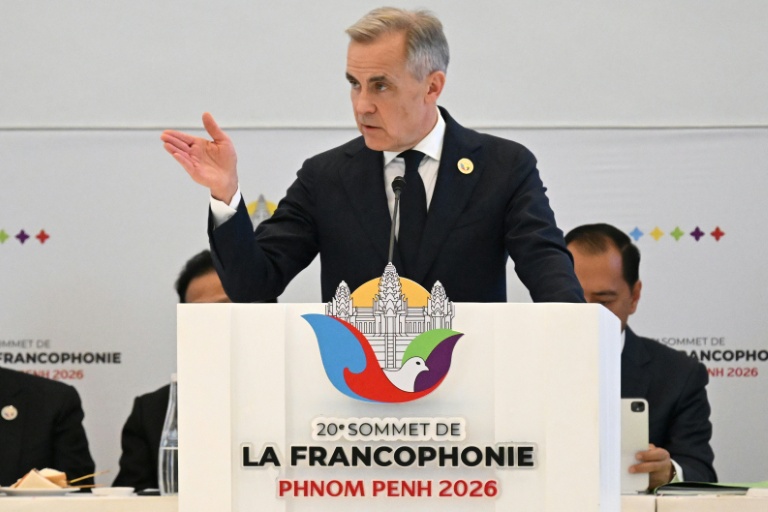

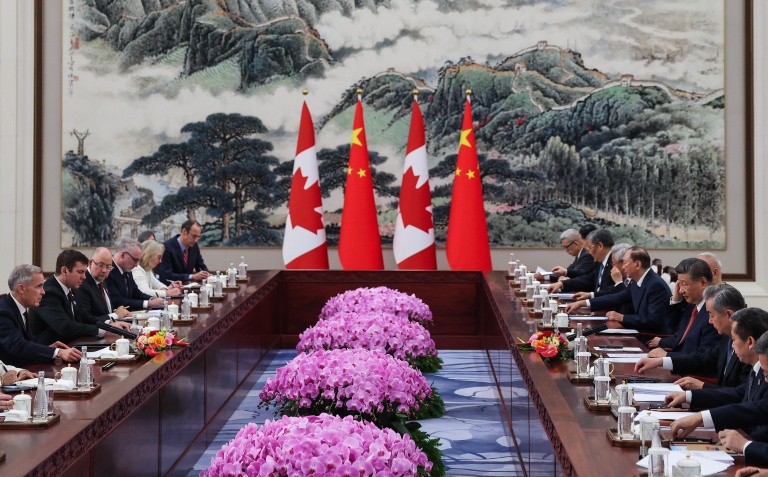
Shenzhen (China) (AFP) – Canada and China announced on Tuesday further tariff cuts for products including seafood and steel, marking a boost to efforts by Prime Minister Mark Carney to reduce dependence on the United States. The reductions announced after Carney met President Xi Jinping at an APEC gathering in China build on a landmark January deal to drop mutual trade barriers and patch up relations.
“Facts have proven that improving and developing China-Canada relations serves the interests of the people of both countries and is also conducive to safeguarding world peace, stability, development and prosperity. This is the right choice,” Xi said, hailing a “turnaround” in ties. “The development of China-Canada relations over the years has taught us important lessons: we must respect each other, uphold equality and mutual benefit, and seek common ground while reserving differences,” the Chinese leader said.
To date, Canada has “restored market access” for more than 90 percent of trade previously subject to tariffs, or nearly CAN$7.5 billion ($5.2 billion) worth of Canadian exports, a statement from Carney’s office said. “To build on that success… (the) leaders agreed on new measures that will further expand trade between their two countries,” it said. This includes extra tariff relief for approximately CAN$400 million in Canadian exports, including CAN$116 million in exports of frozen pork cuts and CAN$285 million in fish and seafood.
In exchange, Canada has agreed to extend by two years existing remission measures for certain Chinese steel and aluminium products currently set to expire at the end of 2026, the statement said.
– ‘Ahead of schedule’ –
Carney said that Canada was “well ahead of our schedule” to increase exports to China by 50 percent by the end of this decade. Carney’s visit to Beijing in January was the first by a Canadian prime minister since 2017, seeking to turn the page on years of diplomatic spats, tit-for-tat arrests and tariff disputes. Ties withered in 2018 over Canada’s arrest of the daughter of Huawei’s founder on a US warrant, and China’s retaliatory detention of two Canadians on espionage charges.
The two countries imposed tariffs on each other’s exports in the years that ensued, with China also accused of interfering in Canada’s elections. The January deal saw China drop tariffs on key Canadian agriculture exports, while Canada allowed up to 49,000 Chinese-made electric vehicles to be imported under reduced levies.
– Trump tariffs –
US President Donald Trump imposed punishing tariffs on Canada’s auto sector last year and has repeatedly said he wants cars sold in the United States to be made exclusively by American workers. Carney walked away from trade talks with Trump in August, but Ottawa and Washington have sounded optimistic about prospects for a deal in recent weeks.
Carney said on Saturday that Ottawa had concluded negotiations for a free-trade pact with the Philippines. He added that a broader agreement was also in the works with the entirety of the 11-member Association of Southeast Asian Nations (ASEAN). The pacts were “part of a strategy of developing a dense web of reliable partners to create more opportunities… and reducing our relative reliance on the United States,” Carney said.
Trump was expected to hold talks with Xi on the sidelines of the APEC gathering this week, as well as a trilateral meeting with Russian President Vladimir Putin.
© 2024 AFP