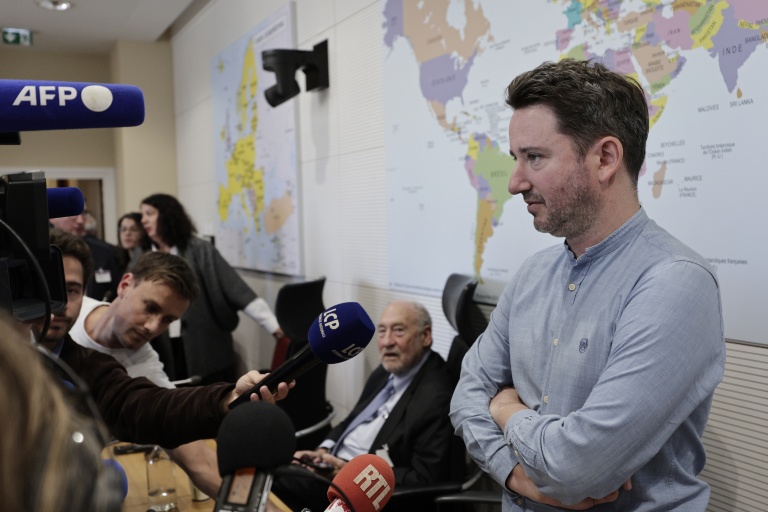
Paris (France) (AFP) – Efforts to tax the ultra-wealthy more will build worldwide despite the recent defeat of a one-time levy on billionaires in California, the French inequality specialist Gabriel Zucman told AFP in an interview Friday. Ahead of a Paris gathering of top economists, politicians, and other specialists this weekend, Zucman also said minimum tax rates on the rich were necessary to prevent an “international oligarchy.”
A manifesto signed by Zucman and around 100 others that forms the basis for the Paris summit warns of a threat to democracy from the growing concentration of wealth and political power worldwide.
Question: Along with a minimum tax of two percent on people with assets worth more than $100 million, the manifesto calls for levies of around 25 percent to recover “unpaid” taxes by the most wealthy. How would this work?
Answer: “The minimum tax is needed because studies have shown the problem of fiscal injustice in all countries. In France, billionaires pay half as much in taxes relative to their income as the rest of the population. And the fact that the number of huge fortunes has exploded in recent years is in large part because they pay little in tax… in such a context, it’s perfectly justified to make that up, to adjust for these unpaid dues. Unlike taxes on capital, or one-time taxes that historically have existed, you could let all affected taxpayers deduct what they’ve paid over the previous 15 years.”
Q: California recently rejected a one-time five percent tax on billionaires, by around 52 percent to 48 percent. And a minimum wealth tax recently failed to secure approval in the French Parliament. Do you think such taxes will ever be imposed?
A: “We’re at the very beginning of an international movement to tax the ultra-rich, which began in 2024 during the G20 summit hosted by Brazil. In just a few years, this international movement has taken off. History shows that these fights take time simply because the wealthy defend themselves with the resources they have at hand. As more citizens seize these initiatives, I think we can confidently imagine their adoption in the coming years. And if California doesn’t do it first, another country will.”
Q: To protect media independence, the manifesto calls for giving employees a “right of dismissal” of shareholders under certain conditions. Why?
A: “A minimum tax of two percent on the wealthy is not enough on its own to let pro-democracy forces win the day against oligarchs. We have to reinforce the democratic infrastructure, in particular by guaranteeing the independence of the media against oligarchic pressures and the interference of wealthy individuals who own a significant part of the private media in many countries, including France.”
Q: Researchers, politicians, and even AI executives have warned about the dangers of artificial intelligence. You criticise the profit-model for AI and are calling for a democratisation of governance at these companies.
A: “We have to guarantee equal access to the knowledge and information that artificial intelligence is appropriating. AI siphons off the knowledge of the entire world, then reconstitutes it and offers it to users who pay. All this appropriation of knowledge, for the moment, is subject to hardly any oversight, and all decisions are left to the discretion of a few oligarchs in Silicon Valley. Since these companies are appropriating all of humanity’s knowledge, it’s not crazy that they belong to all of humanity in the form of nonprofit foundations.”
© 2024 AFP