
Dhaka (AFP) – Bangladesh’s garment workers won a 36-percent minimum wage increase on Wednesday, officials said, after weeks of sometimes violent protests that caused hundreds of millions of dollars in business losses. The South Asian nation, the world’s second-biggest garment exporter behind China, has seen widespread demonstrations since October by workers demanding higher pay. The garment industry, which clothes millions of consumers across Europe and North America, is Bangladesh’s economic lifeline, accounting for four-fifths of export earnings and employing more than four million people.
Following lengthy negotiations with factory owners, workers’ representatives urged employees to return to factories. “Although we are not completely satisfied, the outcome is not entirely bad either,” Babul Akhter, the workers’ representative on a wage board set up to resolve the crisis, told reporters. “Previously, workers used to get a wage revision every five years, but this time they are getting a revised wage after three years.”
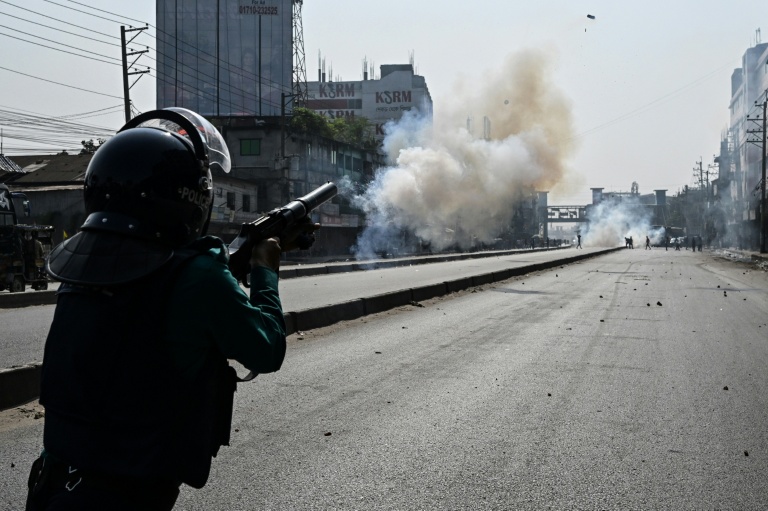
On Wednesday, several hundred protesters set up barricades in the industrial zone of Gazipur, on the outskirts of the capital Dhaka, some hurling rocks, before police dispersed them using tear gas and stun grenades, witnesses told AFP. Police official Md Amzad Hossain said officers were “trying to keep things under control.” Protests later eased, although several factories remained closed.
“Do you think we should be happy with the raise?” Al Amin, a worker in Gazipur, told AFP. “The increased salary still does not match the rising prices of commodities… But I guess most workers want to return to work.” Kamrul Hasan, senior union official from the Ekota Garments Sramik Federation, said that while the increase fell short of demands, they accepted the offer. “Workers should also consider the situation of medium and small factories — they would not be able to pay much more and would eventually shut down,” he said. “The unrest will gradually recede.”
Mahdi Amin, the prime minister’s adviser on labour, welcomed the pay rise and urged calm. “Let us not be influenced by any kind of propaganda, provocation or misinformation,” he said, the state-news agency BSS reported.
Workers initially demanded a minimum monthly wage of 30,000 taka ($240), up from 12,500 taka. They say their pay has failed to keep pace with the rising cost of food, housing, transport and health care. Judge Syed Azad Subhani, the chairman of the government-appointed garment industry wage board, said the “majority supported a minimum wage of 17,000 taka,” after a vote early Wednesday. The wage hike will take effect in January.
The Bangladesh Garment Manufacturers and Exporters Association (BGMEA) said on Sunday that protests had cost the industry an estimated $428 million in losses, while orders worth $254 million had shifted to other countries. The disruption came ahead of the busy Christmas season. The garment industry, which supplies major international brands including Fruit of the Loom and Levi Strauss, earns around $38 billion a year. Bangladesh supplies more than 150 countries with ready-made garments, according to the BGMEA, which represents around 4,000 factories. The United States is its biggest individual market, while the European Union is its largest trading bloc.
When Bangladesh won independence from Pakistan in 1971, it was among the world’s poorest countries, with its economy devastated by war. The expansion of garment production helped transform the nation of around 170 million people from a predominantly agricultural economy into a major global manufacturing hub. Bangladesh’s central bank calls the garment sector the “country’s export engine,” but its success has been built on a vast, relatively low-paid workforce, with longstanding disputes over wages, working conditions and labour rights.
© 2024 AFP