
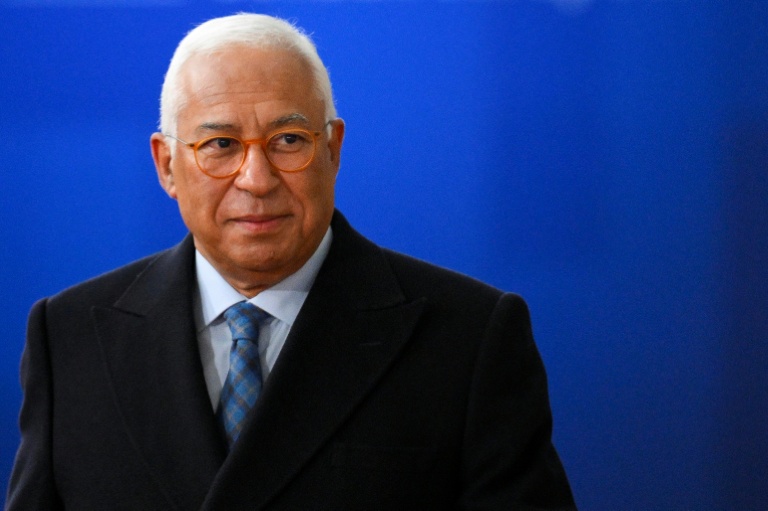
Brussels (Belgium) (AFP) – EU chief Antonio Costa told European leaders Thursday that they needed to strike a budget compromise by year-end, as Brussels races to lock in the plans before looming French elections where far-right leader Marine Le Pen is leading in opinion polls. Wrangling over the size of the European Union’s long-term spending plans was to dominate a summit in Brussels, with Germany pushing for cuts and for burden-sharing on funding for Ukraine, while France presses for a speedy deal.
“Now it is time for all of the leaders to participate in this debate with an open mind, a constructive approach, and a sense of compromise. Because we need to approve this budget timely. That means by the end of this year,” Costa said, arriving at the talks. The bloc’s leaders have spent nearly all of 2026 butting heads over the 2028-2034 budget’s size after the European Commission last year proposed a two-trillion-euro spending plan — disliked by most capitals. The EU wants an agreement by December to avoid tense negotiations spilling into a year of back-to-back elections across Europe.
French President Emmanuel Macron turned up the pressure on the eve of the summit by threatening to walk away if there is no deal before 2027. Currently the frontrunner to succeed Macron next spring, the eurosceptic Le Pen has vowed to slash France’s budget contribution, shelve plans for further EU enlargement, and pull the plug on funding for Ukraine if elected. “The French election is the primary concern,” a senior European diplomat said. “The prospect of a potential Le Pen victory — and its consequences — is always in the back of everyone’s mind.”
But others have pushed back at the narrative of a Le Pen-linked deadline, with Austrian Chancellor Christian Stocker telling reporters he was “certainly not afraid of an election in France.” “Fear is never a good approach, neither in long-term budget negotiations nor in politics in general,” he said.
An already-fraught dealmaking process was made even more difficult after German Chancellor Friedrich Merz linked any resolution of the budget standoff with an agreement on Ukraine funding by all 27 EU countries. Member states are being asked to back an extra 45-billion-euro ($49 billion) loan to help keep Ukraine funded through 2027, but Prague, Budapest, and Bratislava want an opt-out. Merz said on arrival at the summit he considered this a non-starter, warning that “the European Union consists of 27, not 23 or 24.”
The German leader has come under fierce criticism after making any budget agreement conditional upon all EU nations chipping in to finance Ukraine. The three reluctant countries, which opted out of a similar giant loan last year, are normally net recipients of European money. Slovakia’s Prime Minister Robert Fico, who fosters close ties with the Kremlin, has accused Germany of “blackmail,” while Czech leader Andrej Babis vowed on arrival in Brussels to “fight” for EU funds, saying Ukraine financing should be dealt with “separately.”
Leaders are to dissect the latest budget proposal by Costa, who has sought to bridge divisions by slashing the budget by 204 billion euros and proposing revenue from a tax on digital companies. But despite the sense of urgency, leaders and diplomats made clear there was little expectation of a deal this week, with a final summit already planned in late December to get the budget over the line.
“I’m not saying it’s impossible to reach a deal today — it won’t be for lack of effort on my part — but there is still a great deal that needs to happen,” said Prime Minister Rob Jetten of the Netherlands, part of a group of so-called “frugal” EU countries clamouring for a smaller budget. The race to replace European Central Bank chief Christine Lagarde will also be on the summit menu, a key appointment that hinges on a broader French-German deal. Eurozone leaders are set to back Spanish candidate Pablo Hernandez de Cos, current head of the Bank for International Settlements over former Dutch central bank chief Klaas Knot, and a French-German duo, Laurence Boone and Marcus Brunnermeier, for the ECB’s two other top jobs.
© 2024 AFP