

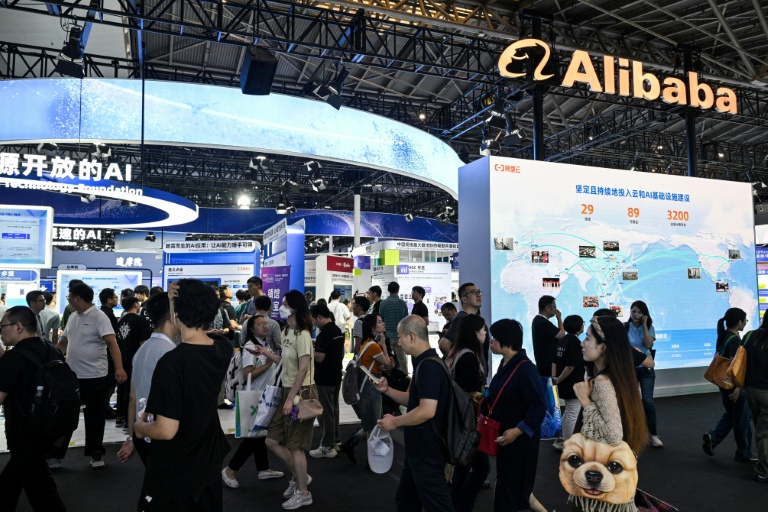
Beijing (AFP) – China’s Alibaba said Thursday that revenue from AI-related products showed strong momentum, even as the tech giant reported a 66 percent year-on-year drop in quarterly net profit. Alibaba, which runs some of China’s biggest online shopping platforms, has seen its core e-commerce business squeezed by price wars and sluggish consumption in the world’s second largest economy. It is ploughing tens of billions of dollars into artificial intelligence — with its shareholders keen to see how the company will approach the tricky task of monetising these huge investments.
“AI is and will continue to be one of our primary growth engines,” CEO Eddie Wu said Thursday, noting that revenue from Alibaba’s Cloud Intelligence Group was up 36 percent on-year in October-December. Net profit plunged 66 percent to 15.6 billion yuan ($2.2 billion) primarily due to a “decrease in income from operations,” the firm said. Total revenue for the period stood at 284.8 billion yuan, missing the estimates of a Bloomberg survey of economists.
China’s tech titans, including Alibaba, are racing to develop AI agents — tools that execute real-life tasks such as sending emails or booking flights, touted as the technology’s next frontier after text and image generators. This week, Alibaba announced an AI agent for businesses called Wukong, currently in beta testing. It follows the unexpected boom in popularity in China of OpenClaw, an agent tool created by an Austrian researcher that has fascinated programmers worldwide despite cybersecurity concerns.
Alibaba’s open-source “Qwen” AI models are popular with programmers worldwide, and CEO Wu said Thursday that Qwen’s consumer interface had surpassed 300 million monthly active users. The company is bringing its AI development and services teams together under the so-called “Alibaba Token Hub,” with the restructuring seen as a bid to focus on profitability.
Max Liu, an AI entrepreneur who has worked with several local AI startup teams, told AFP that Alibaba’s “previous structure was too dispersed, making it hard for all departments to work together.” The OpenClaw phenomenon in China has led big tech companies, including Alibaba, to recognise that “token” — a unit of AI computing power — is becoming a new type of utility, much like water and electricity, Liu said.
© 2024 AFP