

Beijing (AFP) – China imposed export restrictions on dozens of Japanese firms on Tuesday that it said were involved in building up Tokyo’s military, escalating a months-long row. The spat between Asia’s top two economies was sparked by comments by Prime Minister Sanae Takaichi in November that Japan could intervene militarily in any attack on self-ruled Taiwan.
The measures announced on Tuesday cover exports of “dual-use” items — which can have civilian and military uses — to 20 Japanese entities, including subsidiaries of Mitsubishi Heavy Industries and Japan’s space agency. The commerce ministry added a further 20 Japanese organisations, including automaker Subaru, to a “watch list” requiring stricter reviews of exported items that could be used for military purposes. “The above measures are aimed at curbing Japan’s ‘remilitarisation’ and nuclear ambitions and are completely legitimate, reasonable and lawful,” a commerce ministry statement said. “Honest and law-abiding Japanese entities have nothing to worry about,” it added.
A Japanese trade ministry official told AFP that Tokyo would “take appropriate measures” after analysing the impact of the new curbs. Tokyo had strongly protested the measures and demanded they be overturned, according to deputy chief cabinet secretary Kei Sato, who called Beijing’s move “absolutely intolerable and extremely regrettable.” Takaichi’s comments on Taiwan, which China views as its territory and has not ruled out taking by force, have enraged Beijing. The most visible consequence is a sharp drop in Chinese visitors to Japan — 61 percent in January — after Beijing warned its citizens against going there. In December, J-15 jets from China’s Liaoning aircraft carrier twice locked radar on Japanese aircraft in international waters near Okinawa, according to Japan. China has reportedly suspended imports of Japanese seafood. Japan’s last two pandas were also returned to China last month.
China announced tightened controls on exports to Japan for items with potential military uses in January. This fueled worries that Beijing may choke supplies of vital rare-earth minerals, some of which are included in China’s list of “dual-use” goods.
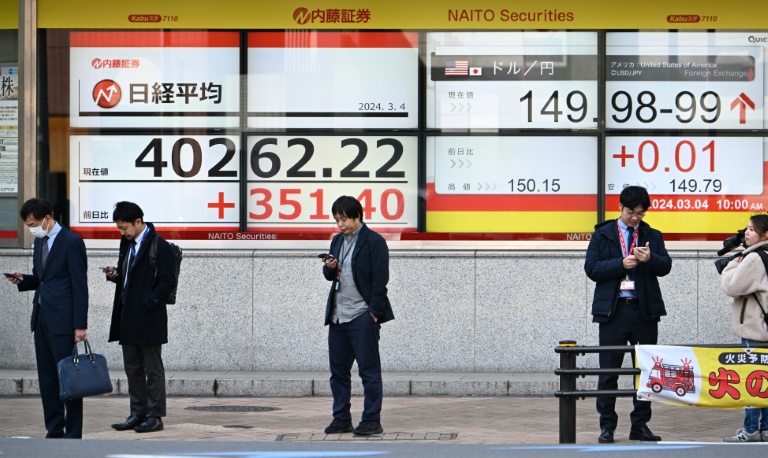
The latest move singles out Japanese industrial heavyweights including shipbuilding and aerospace firms. Shares in Kawasaki Heavy Industries sank almost five percent in Tokyo, while Mitsubishi Heavy Industries shed close to four percent and IHI tumbled nearly seven percent. Several of the firms listed are indeed active in the defence industry, manufacturing kit including ships, fighter jets, and missiles for the Japanese military.
Japan has been shedding its strict pacifist stance, moving to obtain “counterstrike” capabilities and to ease rules on exporting lethal defence equipment. Takaichi’s government in December approved a record defence budget worth nine trillion yen ($58 billion) for the coming fiscal year to expand its military capabilities. Beijing’s top diplomat Wang Yi said at the Munich Security Conference this month that forces in Japan were seeking to “revive militarism.” Takaichi told parliament on Friday that China was intensifying attempts to change the status quo “by force or coercion” in the East China Sea and the South China Sea.
“Strengthening our defence capabilities is essential to protect the lives and peaceful livelihoods of our citizens as we face the most severe and complex security environment since the end of (World War II),” Takaichi said Monday. Japanese firms dealing with China were already struggling with delays in getting approvals, said Noriyuki Kawamura, professor emeritus of Japan-China relations at Nagoya University of Foreign Studies. “With today’s announcement, we can expect the process will be made even more stringent. I believe this will be a huge blow to companies involved,” Kawamura told AFP.
Yee Kuang Heng, a professor in international security at the University of Tokyo, said that Japanese firms are major buyers of critical minerals gallium and germanium from China, with gallium nitride used in radar sensors on Japanese warships. “Short-term impact may be limited with a stockpile to cushion the disruptions but if the controls drag on, some damage is possible,” Heng told AFP.
© 2024 AFP