
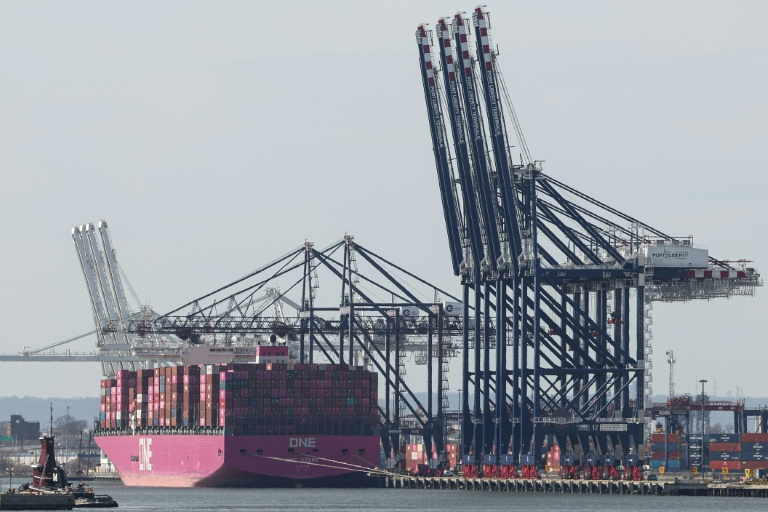
Washington (United States) (AFP) – The US trade deficit widened in February but less than analysts expected, government data showed Thursday, a year since President Donald Trump unleashed sweeping tariffs on virtually all trading partners. One year on, turmoil over Trump’s tariff agenda looks set to continue roiling trade flows in the world’s biggest economy, with ongoing investigations into products and countries threatening new waves of levies.
In February, the overall trade gap expanded 4.9 percent to $57.3 billion as both imports and exports climbed, said the Commerce Department. But the mild shift is yet to fully reflect the Supreme Court’s ruling late in that month to strike down a wide swath of Trump’s duties — including those he announced on April 2 last year on what he dubbed “Liberation Day.” Despite Trump’s vows that his new policies would herald the rebirth of American industry, bringing in jobs, revenue, and an investment boom, critics say that these have not taken place.
Analysts from the conservative-leaning Tax Foundation estimated this week that US tariff policy changed more than 50 times under Trump, adding that tariff revenue through December 2025 accounted for just 4.9 percent of tax receipts for the calendar year. Data also “does not support claims of a large investment surge,” the Tax Foundation said. But Trump’s tariffs have influenced trade flows, with US goods imports from China notably pulling back in 2025.
A Pew Research Center survey released Wednesday said nearly six in 10 US adults are not too — or not at all — confident that Trump can make good decisions about US trade policy. And 63 percent expressed little or no confidence in his handling of tariff policy.
While the high court decision is unlikely to have impacted February’s trade data much, Trump has since turned to different authorities to impose new, temporary 10-percent duties on imports. US officials have launched probes into dozens of countries with an eye on reinstating more lasting tariffs, foreshadowing further trade uncertainty in the months ahead. The high court’s ruling “could definitely impact the data going forward and has opened another window for a front-running wave in imports” as companies try to take advantage of the current lower tariff levels, said KPMG senior economist Meagan Schoenberger.
For now, “higher imports continue to be driven by the tech sector and the AI data center buildout, with most of the increases in computers and semiconductors,” she told AFP. “Most of those items have been exempted from tariffs,” she said. Still in place as well are Trump’s sector-specific tariffs on products like steel, aluminum, and autos, which have been weighing on businesses. The Trump administration has ongoing investigations into other sectors that could lead to more tariff announcements.
February’s deficit was slightly less than the $62 billion expected in surveys of economists by Dow Jones Newswires and The Wall Street Journal. Exports climbed 4.2 percent to $314.8 billion, boosted by goods such as nonmonetary gold and natural gas. US imports jumped by 4.3 percent to $372.1 billion, on the back of products like computers and semiconductors.
© 2024 AFP