
Paris (AFP) – Crucial for making smartphones, fighter jets, and electric cars, “rare earth” metals have become a strategic bargaining chip since main producer China introduced restrictions on their exports this year. As the EU unveils a plan on Wednesday for boosting European production of critical raw materials to reduce reliance on China, here are some facts about these 17 elements and their key uses.
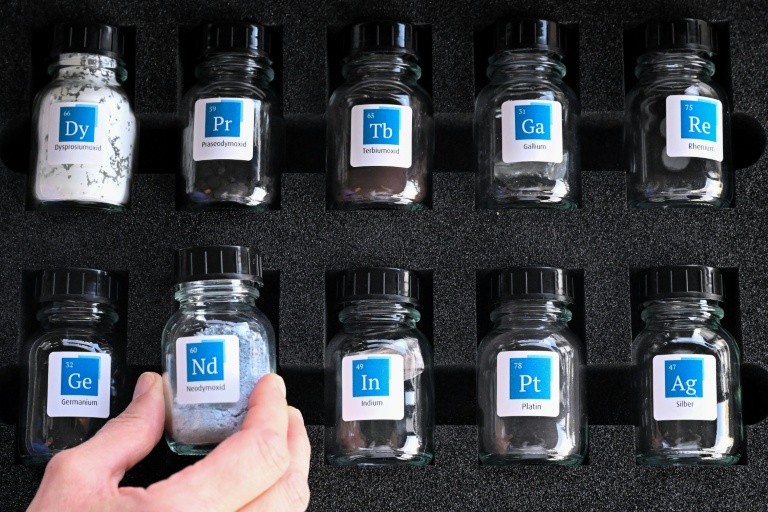
Global raw production of rare earths increased from 220,000 tonnes in 2019 to 390,000 tonnes in 2024 — an increase of 77 percent over five years, according to a benchmark commodities report by French research group Cercle CyclOpe. Four elements account for most of the sector’s economic value: neodymium, praseodymium, dysprosium, and terbium.
These four “magnetic” rare earths are mainly used to make magnets, notably neodymium-iron-boron magnets — about 10 times more powerful than conventional ones. The use of the rare elements maximizes magnets’ performance while reducing size and weight, said Damien Ambroise, energy manager at French consultancy Bartle. A single offshore wind turbine contains up to one tonne of such magnetic rare earths.
Aviation is a major consumer of rare earths, especially for military plane manufacturing. According to the US specialist newsletter Rare Earth Exchanges, US aerospace firm Lockheed Martin is the biggest American user of samarium, employed to make magnets that can withstand extremely high temperatures. Each F-35 fighter jet requires more than 400 kilograms of rare earths, according to a report by the US Congressional Research Service. Scandium is used to make light, strong aluminium-based alloys prized in aerospace — and also in high-end sports gear such as golf clubs, bicycles, and baseball bats.
Rare earths are also found in every smartphone, enhancing screen performance and enabling the phone to vibrate. Each handset contains about three grams of them — more than 3,700 tonnes overall for the 1.24 billion devices sold worldwide in 2024.
Each hybrid or electric vehicle battery and motor contains between 1.2 and 3.5 kilograms of rare earths, according to an estimate by France’s Bureau of Geological and Mining Research. They are also used in the manufacture of miniature motors, such as those that fold away a car’s wing mirrors automatically when it is parked. Combustion-engine vehicles use rare earths too, notably in catalytic converters. Lanthanum and cerium help cut fine particle emissions.
In the chemical industry, cerium is widely used in oil refining and glass polishing — as well as in flints for cigarette lighters. Erbium is used in various medical fields, including dentistry, dermatology, and ophthalmology. Erbium and neodymium are also important in making lasers for industrial engraving and cutting. Adding different rare earths alters the wavelength of the laser, and thus its use and color, Ambroise said. “It makes for pretty colors in sound-and-light shows.”
© 2024 AFP