
EconomyLens.com
No Result
View All Result
Sunday, September 13, 2026
  • Home
  • Economy
  • Business
  • Markets
  • Tech
  • Editorials
EconomyLens.com
  • Home
  • Economy
  • Business
  • Markets
  • Tech
  • Editorials
No Result
View All Result
EconomyLens.com
No Result
View All Result
Home Economy

What next for Venezuela as Trump goes after oil revenues?

Emma Reilly by Emma Reilly
April 1, 2025
in Economy
Reading Time: 7 mins read
A A
0
31
SHARES
385
VIEWS
Share on FacebookShare on Twitter

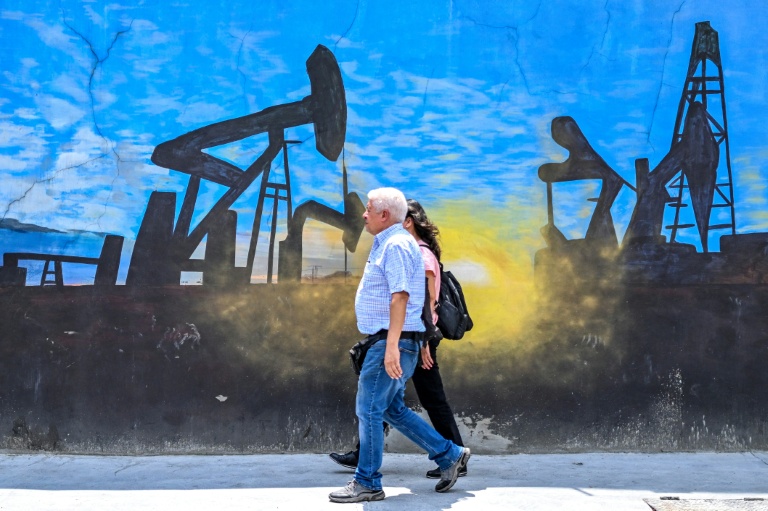
Venezuela's oil industry, one of its few revenue spinners, is in trouble after the United States revoked the licenses of US and transnational energy firms operating in the country. ©AFP

Caracas (AFP) – President Donald Trump has revoked the licenses that allowed several transnational oil and gas companies to operate in Venezuela despite the country being under US sanctions. After US energy giant Chevron, Washington has ordered a handful of other energy firms, including Spain’s Repsol and France’s Maurel & Prom, to cease operating in Venezuela. Trump, who is seeking to force out authoritarian President Nicolas Maduro, has also announced plans for 25 percent tariffs on imports from any country buying Venezuelan oil and gas.

Related

Lights out in Laos as electricity exports surge

Europe saw record summer air traffic despite Mideast war: Eurocontrol

US braces for inflation report that may push Fed to hike rates

Carney says in touch with Trump, Canada ready for ‘fair’ trade deal

What to know about Trump’s $5,000 ‘dividend’ pledge

What’s next for the struggling Caribbean country, which has the world’s largest-known oil reserves but has become increasingly isolated since the July 2024 elections that President Nicolas Maduro is accused of stealing?

– Will the oil stop flowing? –

In 2019, during his first term in office, Trump imposed an embargo on Venezuelan oil in response to the 2018 elections that were already marred by fraud allegations. Venezuela’s state-owned PDVSA oil giant was in freefall at the time, beset by corruption scandals, mismanagement, and a crippling lack of investment. Oil output buckled under the weight of the sanctions, falling from around three million barrels per day at the start of the 2000s to below 400,000 b/d in 2020. The sector recovered some ground after former US president Joe Biden in 2022 eased the sanctions in return for a promise by Maduro to allow fair elections. Biden later reimposed most sanctions when it became clear that Maduro was not keeping his side of the bargain, but allowed Chevron to continue operations.

Today, Venezuela produces around 900,000 barrels per day, of which Chevron contributes about 220,000, Repsol about 60,000, and Maurel & Prom between 20,000 and 25,000. Washington has given Chevron and the other companies until May 27 to wind up their operations. “PDVSA …now has some operational capacity, although we don’t know how big it is,” Gilberto Morillo, PDVSA’s former financial manager told AFP.

– Who will buy it? –

Even if PDVSA manages to keep pumping oil, finding a way to monetize it “is another matter,” Morillo said, pointing to the threatened 25-percent US tariffs on countries that buy its crude. In February, Venezuela exported approximately 500,000 barrels per day to China, 240,000 to the United States, and 70,000 to India and Spain. In the past, sanctions forced PDVSA to discount the oil and to find partners to circumvent the sanctions. Caracas also attempted to trade crude oil through a cryptocurrency scheme, which ended with then oil minister Tareck El Aissami being jailed for corruption in a case that cost the country more than $15 billion, according to media reports.

– What impact for the economy? –

The situation looks set to pile further misery on an economy already in tatters. The price of dollars has soared on the black market as Venezuelans fear falling oil revenue will trigger another bout of hyperinflation and a return to the kind of deep recession the country experienced between 2014 and 2021. The forced pullout of gas producers could also have an impact on the country’s crumbling energy infrastructure, leading to more blackouts.

Repsol pointed out that 85 percent of its operations in Venezuela were related to the production of natural gas, which it warned “supports part of the electricity network.” The cancellation of the licenses will prevent PDVSA from using oil to pay the foreign energy companies for gas, as it had been doing, Morillo explained. “If PDVSA can’t pay them, then it generates a debt,” he said. But if the energy firms decide “ok, we’ll close down and leave…they would lose their entire investment,” he argued.

© 2024 AFP
Tags: energysanctionsVenezuela
Share12Tweet8Share2Pin3Send
Previous Post

Tariffs: Economic ‘liberation’ or straitjacket?

Next Post

Political support leading to increasing fallout for crypto

Emma Reilly

Emma Reilly

Related Posts

Economy

UAE to invest 40 billion euros in Germany, including for data centres: Berlin

September 11, 2026
Economy

US producer inflation tops expectations as diesel costs jump

September 11, 2026
Economy

ECB hikes borrowing costs to combat Mideast energy shock

September 10, 2026
Economy

Will Israel’s right exploit sanctions in run-up to vote?

September 10, 2026
Economy

Eurozone rate-setters to hike borrowing costs as energy prices jump

September 10, 2026
Economy

EU wants to edge out China in public contracts

September 9, 2026
Next Post

Political support leading to increasing fallout for crypto

Trump tariffs threaten Latin American steel industry

Stock markets edge up but Trump tariff fears dampen mood

'Heartbreaking' floods swamp Australia's cattle country

0 0 votes
Article Rating
Subscribe
Notify of
guest
guest
0 Comments
Oldest
Newest Most Voted
  • Trending
  • Comments
  • Latest

New York ruling deals Trump business a major blow

September 30, 2024

Elon Musk’s X fights Australian watchdog over church stabbing posts

April 21, 2024

Women journalists bear the brunt of cyberbullying

April 22, 2024

France probes TotalEnergies over 2021 Mozambique attack

May 6, 2024

New York ruling deals Trump business a major blow

104

Ghanaian finance ministry warns against fallout from anti-LGBTQ law

74

Shady bleaching jabs fuel health fears, scams in W. Africa

71

Stock markets waver, oil prices edge up

65

Trump administration reluctant to slow AI, Democrats see urgent need

September 13, 2026

US House Speaker warns curbing AI too sharply could leave China ahead

September 13, 2026

Iran’s economic ties to Dubai hard to break despite war

September 13, 2026

Lights out in Laos as electricity exports surge

September 12, 2026
EconomyLens Logo

We bring the world economy to you. Get the latest news and insights on the global economy, from trade and finance to technology and innovation.

Your Privacy Choices

Pages

  • Home
  • About Us
  • Privacy Policy
  • Contact Us

Categories

  • Business
  • Economy
  • Markets
  • Tech
  • Editorials

Network

  • Coolinarco.com
  • CasualSelf.com
  • Fit.CasualSelf.com
  • Sport.CasualSelf.com
  • SportBeep.com
  • MachinaSphere.com
  • MagnifyPost.com
  • TodayAiNews.com
  • VideosArena.com
© 2026 EconomyLens.com - Top economic news from around the world.
No Result
View All Result
  • Home
  • Economy
  • Business
  • Markets
  • Tech
  • Editorials

© 2024 EconomyLens.com - Top economic news from around the world.