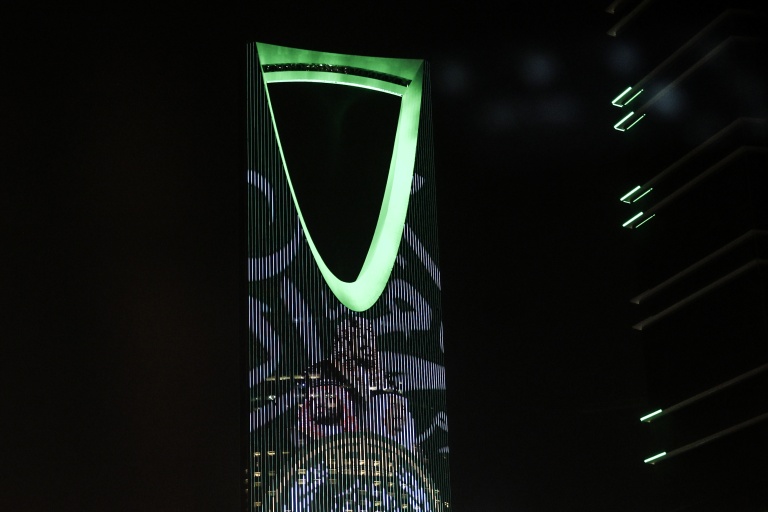

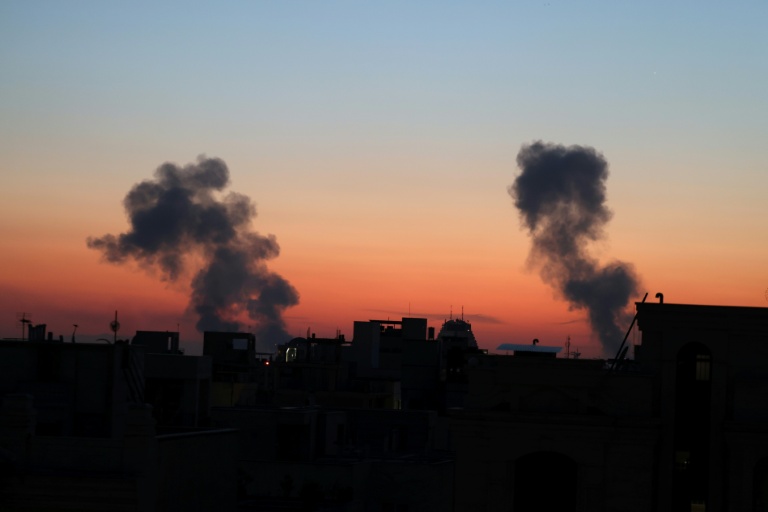
Tehran (AFP) – Israel announced a new wave of “broad-scale” strikes on Tehran on Saturday, as US President Donald Trump stated that only Iran’s unconditional surrender would bring an end to the escalating Middle East war. Iran launched attacks on Israel and its Gulf neighbors, with Saudi Arabia reporting that it had intercepted a ballistic missile fired at the Prince Sultan Air Base near Riyadh, which houses US military personnel.
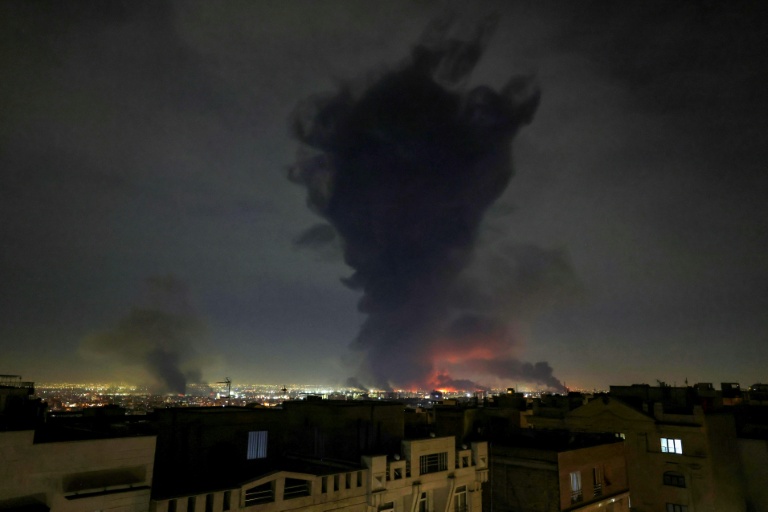
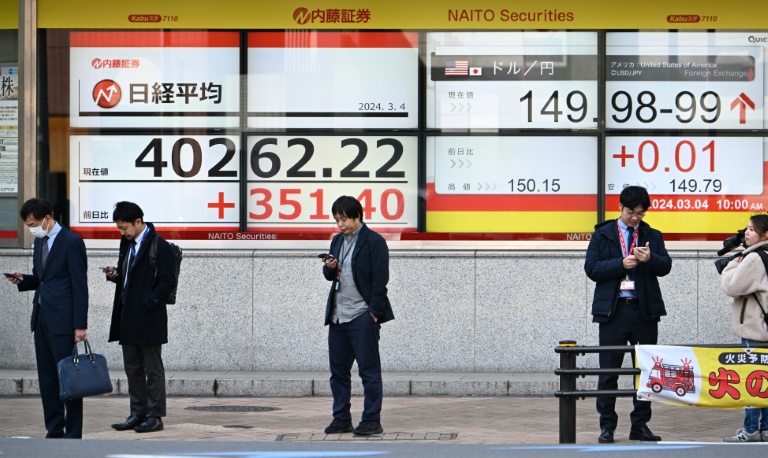
Crude oil prices surged on mounting fears about global supply disruption, as the US-Israel war on Iran and Tehran’s pressure on the Strait of Hormuz upend the world’s energy and transport sectors. The international benchmark oil contract, Brent North Sea crude, jumped to $92.69 per barrel on Friday, up 8.5 percent on the day and nearly 30 percent for the week. The Israeli military stated early Saturday that it had launched a “broad-scale wave of strikes” on government targets in Tehran. Iran’s state broadcaster reported an explosion in the western part of the capital, but further details were not immediately available.
US Central Command, responsible for US forces in the Middle East, reported that over 3,000 Iranian targets had been struck over the past week, including Revolutionary Guard headquarters, command-and-control centers, air defense systems, missile sites, navy warships, and submarines. US Defense Secretary Pete Hegseth mentioned that the United States is “not concerned” about reports that Russia is providing intelligence to Iran on US troop positions and movements. While declining to confirm the reports, Hegseth stated in an interview with CBS’s “60 Minutes,” “We’re tracking everything.”
The renewed Israeli attacks on Tehran came a day after Israel intensified its air strikes on Lebanon, targeting Beirut’s southern suburbs, where the Iran-backed militant group Hezbollah holds sway, and Baalbeck in the east.
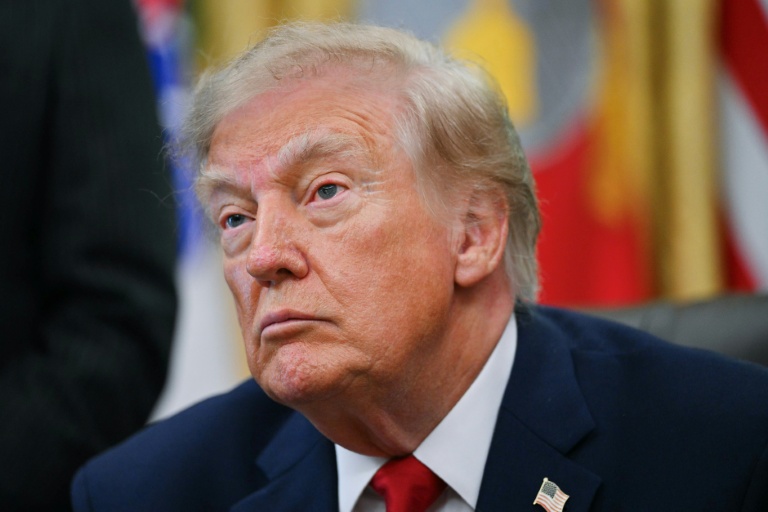
UN Secretary-General Antonio Guterres appealed for “serious diplomatic negotiations” and warned of a “situation that could spiral beyond anyone’s control.” Russian President Vladimir Putin expressed support for an “immediate” ceasefire in Iran during a phone call with Iranian counterpart Masoud Pezeshkian on Friday, according to the Kremlin. Trump, who has given varying reasons for starting the war, has spurned fresh talks with Tehran, stating on Truth Social that “there will be no deal with Iran except UNCONDITIONAL SURRENDER.”
White House Press Secretary Karoline Leavitt noted that when the president determines Iran no longer poses a threat to the United States and the operation’s goals are realized, “Iran will essentially be in a place of unconditional surrender, whether they say it themselves or not.” Trump also promised to help rebuild the country’s economy if Tehran installs someone “acceptable” to him to replace Iran’s supreme leader Ayatollah Ali Khamenei, who was killed last weekend. Amir Saeid Iravani, Iran’s ambassador to the United Nations, emphasized that the United States would have no role in selecting Khamenei’s successor, stating, “The selection of Iran’s leadership will take place strictly in accordance with our constitutional procedures and solely by the will of the Iranian people, without any foreign interference.”
Six US service members have died, and Trump is set to attend the return of their bodies at a dignified transfer ceremony at Dover Air Force Base in Delaware on Saturday. Lebanon’s health ministry reported at least 217 fatalities due to Israeli airstrikes, with Prime Minister Nawaf Salam warning that a “humanitarian disaster is looming.” The Norwegian Refugee Council stated that 300,000 people in Lebanon had been forced to flee their homes. Three UN peacekeepers were wounded when their base in southern Lebanon was hit on Friday. The UN force and the Ghanaian military confirmed the incident, and Lebanese President Joseph Aoun accused Israel of targeting them. French President Emmanuel Macron condemned the attack as “unacceptable.”
Tehran was subjected to heavy Israeli strikes on Friday, described by AFP journalists as among the most intense bombardments to date. According to Iran’s health ministry, the US and Israeli strikes have resulted in 926 fatalities, a figure that AFP could not independently verify. Iran has launched missile and drone attacks on Israel and Gulf states since the onset of the war, resulting in at least 10 deaths in Israel, according to first responders. Qatar reported being targeted by 10 Iranian drones on Friday, of which nine were intercepted, while the other landed in an uninhabited area.
Drones also struck airports and oil facilities in Iraq on Friday, targeting Iranian Kurdish opposition groups in the northern Kurdistan region, according to security officials. Tehran has effectively blocked the Strait of Hormuz, the narrow but critical energy waterway through which tankers typically move nearly 20 percent of the world’s crude oil and about 20 percent of liquefied natural gas from the Gulf. Thirteen people, seven of them civilians, have been killed in Gulf countries since the war began, including an 11-year-old girl, Elena Abdullah Hussein, in Kuwait. Two hours before her death, the girl called her father at work to tell him she loved him. “It was as if she was trying to say goodbye,” her father, Abdullah Hussein, recounted at her funeral.
© 2024 AFP