Lausanne (AFP) – The biggest and most lucrative ever World Cup this summer will also set a record for the most-polluting sporting event in history, environmental experts say. “Unlike the case of the Olympic Games, where the carbon footprints have been reducing over the last several editions, this is totally opposite in the case of FIFA men’s World Cup,” David Gogishvili, a geographer at the University of Lausanne (Unil), told AFP.
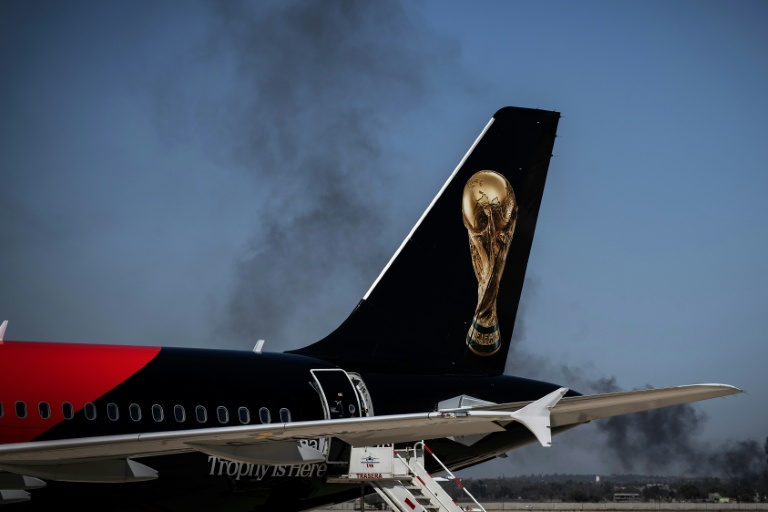
The summer’s World Cup has been expanded to 48 teams for the first time. It will be played in three countries — Mexico, Canada and the United States — also for the first time. It will generate unprecedented revenue but, Unil’s research shows, “produce the largest carbon footprint in the history of international sport”. Unil’s calculations for CO2-generated emissions range from five to nine million tonnes compared to “around 1.75 million tonnes” for the 2024 Paris Olympics, Gogishvili continued. That figure far surpasses the estimated 2.17 million tonnes of CO2 generated by Russia in 2018, in a far-flung World Cup that involved 40 fewer matches, and the 3.17m tonnes from Qatar in 2022, in a highly compact event criticised for its hastily constructed, oversized and air-conditioned stadiums.
All 16 venues for this summer, from the “smallest” in Toronto with 45,000 seats, to the largest in Arlington, Texas, which holds 94,000 seats, already existed when the Games were awarded, a point highlighted in 2018 by the “United 2026” bid. The main issue is the vast span between stadiums. The distance between Miami and Vancouver is more than 4,500 kilometres. That will increase the biggest source of CO2 emissions for international events: air travel for teams, officials, media, and especially the “more than five million fans” targeted by FIFA. Bosnia and Herzegovina, for example, will travel 5,040 kilometres to play group games in Toronto, Los Angeles and finally Seattle.
– **’FIFA’s environmental denial’** – FIFA president Gianni Infantino, who proclaimed his “determination” to combat climate change at COP26 in Glasgow, has pledged to “measure, reduce and offset” emissions related to its World Cups. But, reprimanded in June 2023 by the Swiss Fairness Commission (CSL) for misleadingly promoting the “climate neutrality” of the 2022 World Cup, FIFA has refrained from any guarantees on 2026. Environmental analysts agree that the best way to reduce the impact of mega-competitions is to limit their scale, as the International Olympic Committee has done with its quota of 10,500 athletes for the Summer Games, said Gogishvili.
By increasing its flagship tournament from 32 to 48 teams, a year after increasing its World Club Cup from seven to 32 teams, FIFA is doing the exact opposite. The climate cost of any international match is “26 to 42 times greater than an elite match” at the national level, said a 2025 report published by the New Weather Institute think-tank. “A single match during the final stages of the men’s World Cup is responsible for 44,000 to 72,000 tonnes of CO2,” said the report’s writers from the British-based Scientists for Global Responsibility. That, they calculated, was the equivalent to the emissions of 31,500 to 51,500 British cars over an entire year.
FIFA’s “insatiable appetite for growth”, said Gogishvili, leads to more matches and, inevitably, “more athletes, more fans, more hotel infrastructure, more flights, it’s kind of a never-ending cycle.” The 2030 World Cup will be spread across six countries and three continents. It kicks off with a trio of matches in Argentina, Uruguay, and Paraguay before switching to hosts Morocco, Spain and Portugal for the remaining 101 matches. The 2034 World Cup will be held in Saudi Arabia, in a climate comparable to that of Qatar but with 40 more matches in a much larger country. Saudi giant Aramco, the world’s largest oil company, became a major sponsor of FIFA in 2024.
“It would seem that FIFA’s environmental denial will continue,” Gilles Pache, a professor at Aix-Marseille University, wrote in the Journal of Management Research in 2024.
© 2024 AFP