
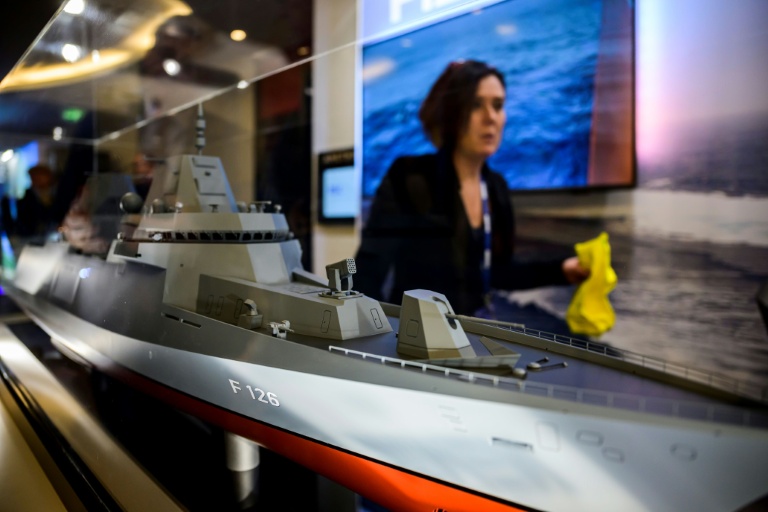
Berlin (AFP) – Germany on Wednesday pulled the plug on its largest naval order in decades after the mammoth warship project suffered lengthy delays, a setback for the country’s ambitions to overhaul its military. The multi-billion-euro project to build six next-generation frigates specialized in anti-submarine warfare was being abandoned in favor of purchasing eight smaller warships, Defence Minister Boris Pistorius said.
“Continuing the project would have involved a significant loss of time, disproportionately high costs, and also considerable risks,” Pistorius stated. Germany had already spent 2.3 billion euros ($2.6 billion) on the troubled project to construct the F126 frigates, which was awarded in 2020 to Dutch shipyard Damen Naval, he conceded. But he added: “Better a hard stop than a permanent limbo. We cannot afford that, neither financially nor in terms of time.”
While the programme had long been in trouble, the announcement nevertheless came as a shock as German defence giant Rheinmetall had been widely expected to take over as lead contractor and complete the frigates. Rheinmetall’s shares dived some 20 percent in Frankfurt following the news. The move is a setback for the EU’s most populous country at a time it was seeking to rapidly build up its long-neglected armed forces to bolster its role in NATO and deter a hostile Russia.
Anti-submarine warfare has become a key focus for European NATO members following suspected Russian submarine manoeuvres near vital undersea cables and pipelines in the Baltic Sea and the Atlantic.
Germany ordered four F126 submarine hunters in 2020 from Damen Naval, with the price set at 10 billion euros (then $11.2 billion), with the deal later expanded to include two more vessels. The first was set to be delivered in 2028, with all due to be operational by 2033, according to the defence ministry. But the project was beset by repeated delays, with the delivery of the first vessel pushed back to 2032. “The navy would not have been able to provide the capabilities it has pledged to NATO in time,” Pistorius noted.
The Financial Times reported there were myriad problems in the complex project, in particular cultural clashes between the Dutch shipyard and German military procurement officials. Damen struggled with officials’ demands for submissions to be on paper as well as for documentation to be in German, the paper reported in April, citing industry sources.
Rheinmetall CEO Armin Papperger told reporters in May that the defence giant, which has seen stellar growth as Europe re-arms, was in talks with Berlin to take over the project, fueling expectations of an imminent deal. But the government ultimately concluded that handing over the work to NVL, a shipyard acquired by Rheinmetall in March, would be too costly, the defence ministry said. Carrying on would have led to an estimated bill of over 18 billion euros, including money already spent as well as 15.2 billion euros for NVL to take it on. It would have also meant the government forgoing a contractual right to sue Damen Naval for damages, the ministry added.
Pistorius said the government would seek to claw back some of the money spent on the doomed project but conceded there was “little prospect of success.” Instead of the F126s, Berlin will instead order eight smaller vessels of a type long in service from rival German contractor TKMS. Under the plan, the government will pay 6.3 billion euros for four MEKO A-2000 frigates with an option to purchase another four for about 5.3 billion euros. TKMS shares were up 16 percent following the news.
The saga throws a spotlight on the challenges for Germany’s massive military buildup, in particular slow and complex procurement processes. Berlin has earmarked hundreds of billions of euros for rearmament over the coming decade, exempting most defence spending from strict constitutional borrowing limits.
© 2024 AFP