
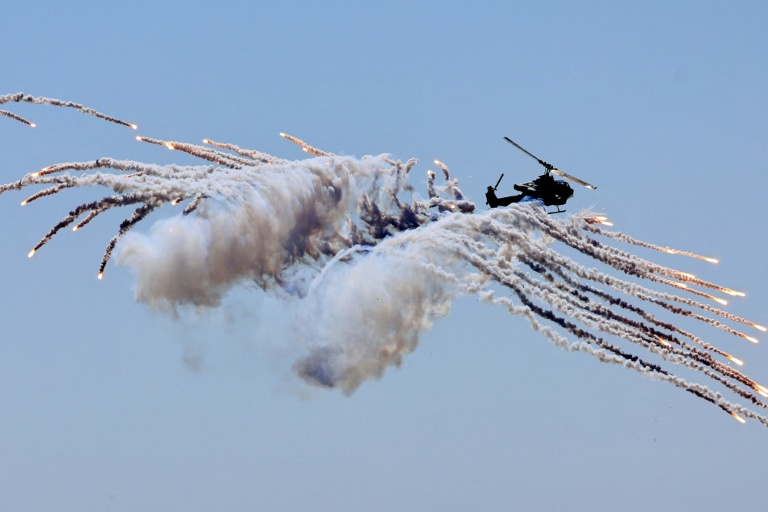
Izmir (Turkey) (AFP) – For years overlooked by its NATO partners, Turkey’s defence industry appears to have found its place among the military alliance’s major players, thanks to an ambitious policy driven from the top. Turkish arms manufacturers saw their turnover increase fifteen-fold between 2002 and 2023, specialist defence website TurDef reports, while exports rose from around $800 million in 2010 to $7.1 billion in 2024. “Ten years ago, when we spoke about the Turkish defence industry, people would laugh. Not any more,” says TurDef founder Ozgur Eksi. “Turkey designs, develops and produces a large part of its own defence equipment,” notes retired French brigadier general Patrice Moyeuvre, head of defence and security at Advantis consultancy. “Its efforts have paid off, and this can be seen, in particular, in its export success,” he told AFP.
Things began to change in 1974 when the US imposed an arms embargo on Ankara following its invasion of northern Cyprus. The move laid bare Turkey’s isolation and vulnerability in a volatile region wedged between the Caucasus, the crumbling Soviet bloc, and the Middle East. In the following years, Turkey established firms that have gone on to become giants: defence electronics giant Aselsan; defence software and systems expert Havelsan; aerospace manufacturer TUSAS; missile and rocket manufacturer Roketsan, and others.
Then in 2004, Ankara stopped buying off-the-shelf systems from abroad and brought weapons development in-house, placing the entire sector under its state Defence Industry Agency (SSB) that reports directly to the president. “Given Turkey’s geostrategic location… the imperative for a coherent and forward-looking national strategy is clear,” says Ugur Tarcin, a professor at Istanbul’s Marmara University. Over the past decade, Ankara has “exported 230 different types of defence products to 185 countries”—an achievement which “reflects both the versatility and competitiveness” of its capabilities, he said. Drones produced by Baykar and TUSAS are now ubiquitous across modern-day battlefields.
“We’ve made huge leaps in terms of in-house developed products,” said a Turkish industrialist who agreed to speak on condition of anonymity. “We needed to develop different mechanisms for the war against PKK, in particular in surveillance,” he said, referring to the Kurdish militants who have fought Ankara for decades. “We could not get help from abroad and could not get it from fighter jets. So, we started to develop drones.”
For the past three years, Turkey has seen orders pouring in, becoming the world’s 11th largest arms exporter, according to Tarcin. “Particularly notable has been its investment in and testing of advanced systems, including surface-to-air and air-to-surface missiles, drones, and the command networks that enable them to operate,” analyst Tom Barton, with London-based intelligence firm Janes, told AFP. “Turkey is now seen as a supplier of choice, competing with European and US companies, especially for Middle Eastern and Asian customers.” Aselsan just marked its 51st birthday by destroying a swarm of drones with its new high-power electromagnetic Ejderha system—the “world’s first system to successfully neutralise 51 drones with a single push of a button, without firing a missile or using any ammunition,” claimed its CEO Ahmet Akyol.
Turkey’s new position is reflected in its hosting of a NATO summit this past July and of NATO Edge this week, focusing on the alliance’s critical technology and digital weaponry. Even so, Ankara still faces mistrust from some NATO partners, notably Paris and Berlin, amid clashing regional and strategic interests. For President Recep Tayyip Erdogan, Turkey’s independence is the cornerstone of his foreign policy, whether speaking with Washington, Kyiv, Moscow, or Tehran. “You know the slogan: Keep your friends close, your enemies even closer,” says a Turkish military expert who asked to remain anonymous. “We’re the belly dancer, but we have to dance with everyone… This is the Middle East, not Europe. Everything’s possible. Ankara needs to be practical.”
© 2024 AFP