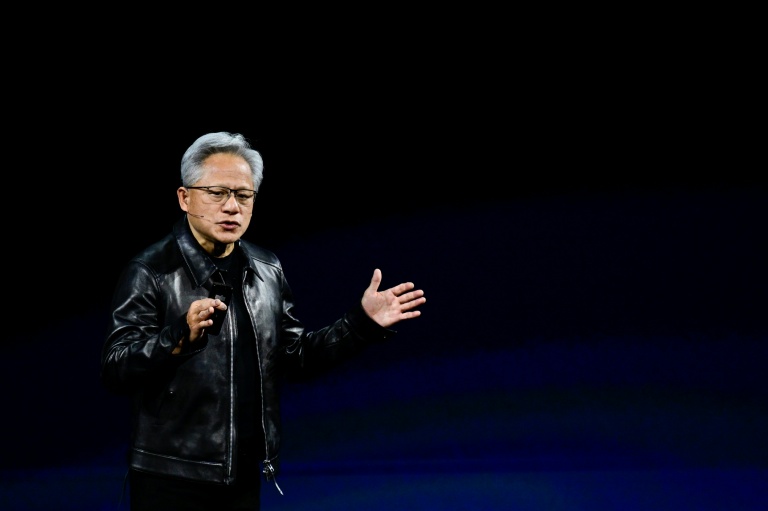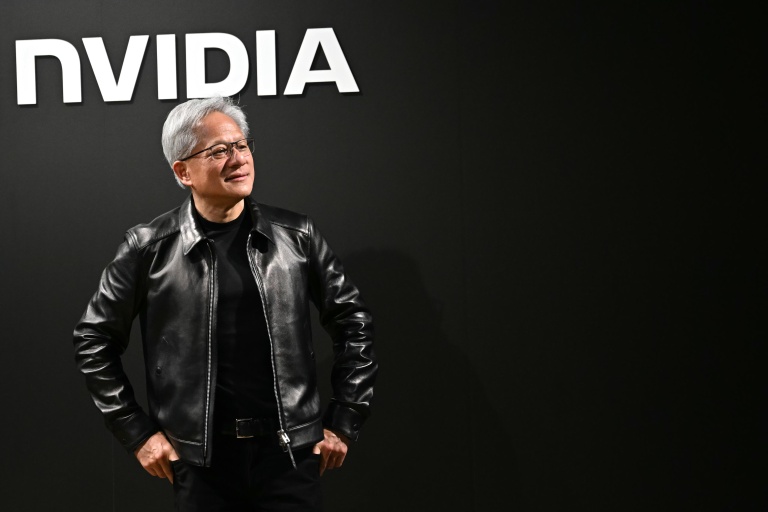

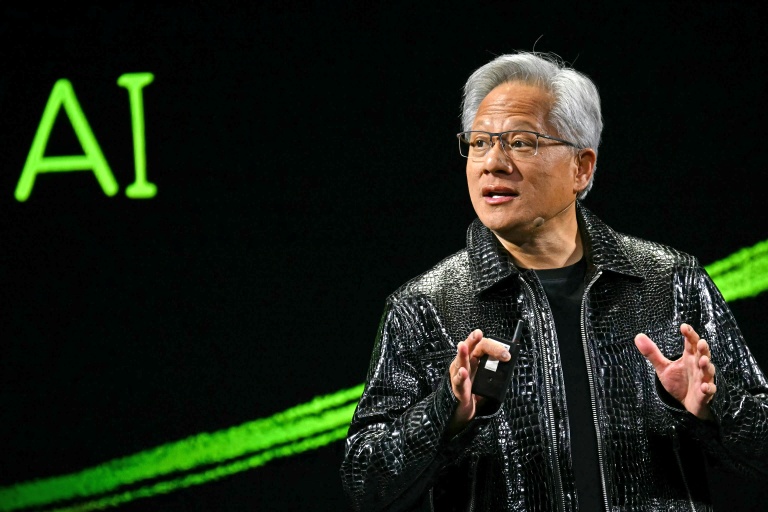
San Francisco (United States) (AFP) – He had rock star status, and now the artificial intelligence industry is weighing who can fill the shoes of Jensen Huang after his forced exit from US chip king Nvidia left the “central bank of AI” without its longtime leader. Huang’s abrupt fall comes at a sensitive time for the sector, just days before the closely watched IPO of AI firm Anthropic and amid mounting concerns about the financial soundness of the industry’s colossal investment spree.
Before his resignation on Thursday after details emerged about multiple extramarital affairs, including with a suspected Chinese spy, Huang had positioned himself as a major booster for the AI industry across both political and financial lines. He had built close ties to Donald Trump, accompanying him on Air Force One earlier this year when the US president traveled to Beijing for a summit with Chinese leader Xi Jinping. And while other executives called for slowing down AI development over safety concerns, Huang pushed for plowing forward — perhaps not surprising from the head of a company that has poured billions into companies, data centers, and chip deals from which it stands to profit. Those efforts sparked questions about so-called circular dealmaking, highlighting the potentially fragile nature of Nvidia’s financing activities.
Among those deals was a more than $100 billion financing guarantee for a new data center in Ohio for ChatGPT-maker OpenAI. Nvidia has also committed to buying $10 billion worth of shares in Anthropic’s IPO next week.
– Stable, or chaos? –
The chip designer’s growth appears solid for now, with TF International Securities analyst Ming-Chi Kuo writing on X that the CEO transition would not affect Nvidia’s “product development and competitiveness” until 2028 at the earliest. Nvidia CFO Colette Kress was named interim CEO on Thursday. But expect “chaos,” warned Gary Marcus, a longtime tech industry critic, who wrote on Substack that “things will clearly never be the same, neither for Nvidia, nor the AI industry as a whole. Congressional investigations will continue. The market may crash.”
Huang persuaded Trump to allow sales of some of Nvidia’s high-end chips to China, despite the rivalry between the two countries and existing export controls. Huang will now be absent when the US president meets Xi next week at the APEC summit in Shenzhen. In a note published Thursday, analyst Dan Ives called the whole saga a “black eye moment” for Huang. However, the situation might “sharpen the sword in the battle and arms race” between the US and China, the note continued. Huang’s resignation also presents an opportunity for the industry. “Other US tech leaders are now going to have [to] step in,” Ives wrote, pointing to Microsoft CEO Satya Nadella, Google CEO Sundar Pichai, and Apple Chairman Tim Cook, among others.
– ‘Huge void’ –
Major Silicon Valley figures lamented Huang’s departure, crediting him with putting Nvidia at the center of the AI boom. “A sad day for Nvidia, developers, America, and all humanity,” Epic Games CEO Tim Sweeney wrote on X. Sweeney said Huang had built one of the few companies to reach massive scale while continuing to innovate, while others “fell into the trap” of choosing profits over innovation. Clement Delangue, CEO of AI platform Hugging Face, which is owned by Nvidia, called it “a really sad day,” saying: “This whole thing sucks, and I wish none of it had happened.” Delangue vowed to “keep fighting for open-source AI, harder than ever.”
“Infidelity is obviously bad,” wrote Shaun Maguire, a partner at venture capital firm Sequoia Capital. “But his contributions to American innovation and AI leadership cannot be overstated.” Maguire warned that Huang’s exit would leave “a huge void,” adding that “the American AI community needs to work double-time in an attempt to fill this void.” Elon Musk, the world’s richest person, said in a video clip shared on X that it would be “an honor” to hire Huang.
© 2024 AFP