
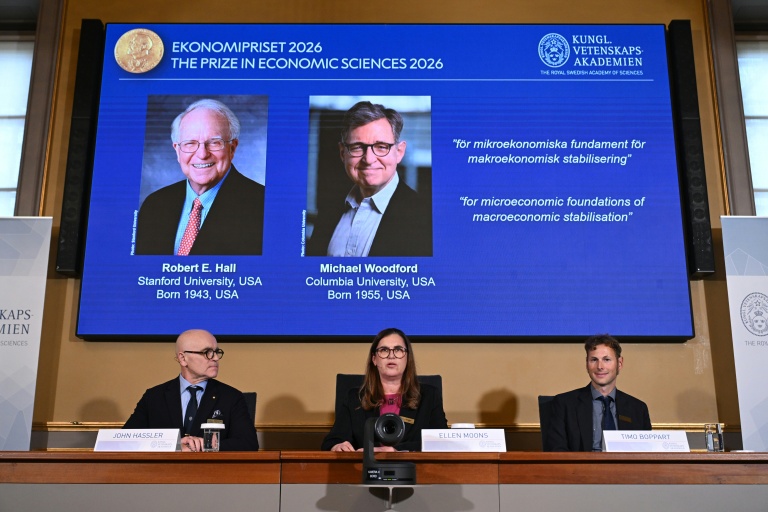
Stockholm (AFP) – Americans Robert Hall and Michael Woodford were awarded the Nobel economics prize Monday for their work on how monetary and fiscal policy can better stabilise disruptive economic fluctuations. The two were honoured for developing new models for managing recessions and other crises that fail to respond to traditional tools.
“On the basis of these models, well-timed fiscal and monetary policy measures can reduce the economy’s peaks and troughs,” the jury said. The Royal Swedish Academy of Sciences explained in a statement that ever since John Maynard Keynes formulated his economic theories almost a century ago, “stabilisation” policies had long let officials boost economic growth when needed. But during the oil shocks in the 1970s, the Keynesian models that governed when and how action should be taken no longer worked.
Hall, 83, a professor at Stanford University, and Woodford, a professor at Columbia University born in 1955, separately began to explore new models. “Rather than basing the models on statistical links between macroeconomic variables, such as inflation, production and consumption, they chose to build them on a microeconomic foundation,” the jury said. Hall and Woodford’s models include an “understanding for how the total mass of individual households and businesses affect the economy through their actions,” it said. A fundamental aspect of this is the understanding that households are forward-looking when making decisions about spending or saving.
– ‘Tremendous honour’ –
This means the way governments and central banks communicate their policies can influence people’s views of the future when making such decisions. “The laureates’ work has provided us with a stable theoretical foundation for the models that are now used by central banks and governments around the world,” John Hassler, chair of the prize-awarding committee, said in a statement.
“It’s a surprise, but I’m feeling very good about it,” Woodford told reporters via phone during the announcement of the prize, saying he felt “elated” over receiving “a tremendous honour.” A concrete example of his work implemented in practice was when the 2008 financial crisis created a situation where “traditional tools of monetary policy were not really adequate to deal with the problem of restoring economic activity,” he said, noting that interest rates were already lowered to zero in many countries.
One of the new approaches employed by central banks was to start making “more explicit statements” on where they believed guiding interest rates were headed in the future, which continues to this day. “I think it did contribute to better stabilisation. It didn’t magically solve the problem, but I think it was an important contribution,” Woodford said.
– ‘Public understanding’ –
While his theories have had a large impact on policymakers, he said they had not been “motivated by a specific political agenda.” “It was an attempt to improve the foundations for discussion of economic policy and therefore to contribute both to the management of the economy, but also to contribute to public understanding,” Woodford said.
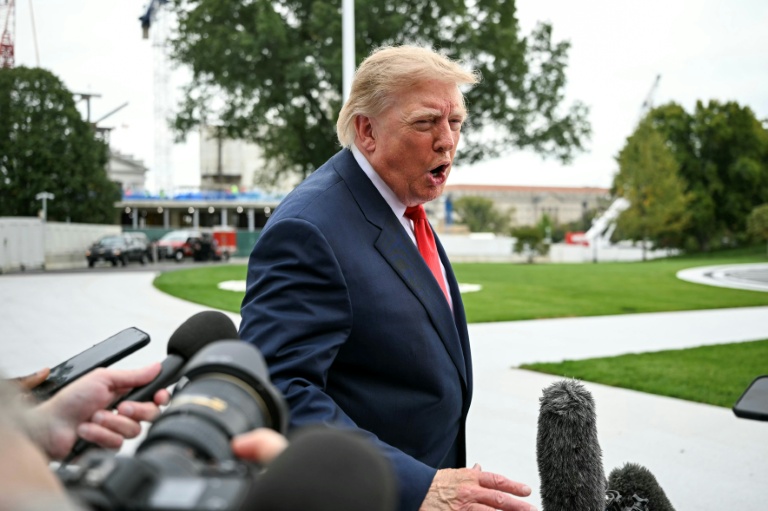
The decision to honour work on monetary policy comes as the US Federal Reserve, the United States central bank — which recently hiked rates to combat inflation — faces unprecedented pressure from President Donald Trump to cut interest rates. The economics prize is the only Nobel not among the original five created in the will of Swedish scientist Alfred Nobel, who died in 1896. It was instead created through a donation from the Swedish central bank in 1968, but like the Nobels in chemistry and physics, the Royal Swedish Academy of Sciences chooses the winner using the same selection process.
Last year, the economics award went to American-Israeli Joel Mokyr, France’s Philippe Aghion, and Canada’s Peter Howitt for research into how technology drives and affects growth. Last week, South African judge Navi Pillay won the peace prize, and Canadian-Icelandic writer Anne Carson was named the literature laureate. The Nobel Prize in Chemistry was awarded to Frenchman Henri Kagan and Kenso Soai of Japan, and the Physics Prize to Belgian Francis Halzen. And the prize in medicine went to American Karl Deisseroth and Germans Peter Hegemann and Georg Nagel.
Like the other Nobels, the economics prize consists of a diploma, a gold medal, and a $1.2 million cheque. bur-jll/po/rl
© 2024 AFP