
Dhaka (AFP) – Bangladesh’s garment industry, which clothes millions of consumers across Europe and North America, is the country’s economic lifeline, generating four-fifths of export earnings and employing more than four million people. The sector’s success has been built on a vast, relatively low-paid workforce, with longstanding disputes over wages, working conditions, and labour rights. Protests erupted on Saturday, with striking garment workers demanding more than double the current minimum monthly wage. Here is a look at the key industry.
– Economic change – When Bangladesh won independence from Pakistan in 1971, it was among the world’s poorest countries, with its economy devastated by war. The expansion of garment manufacturing helped transform the South Asian nation of around 170 million people from a predominantly agricultural economy into a major global manufacturing hub. Bangladesh’s central bank calls the garment sector the “country’s export engine.” The world’s second-largest garment exporter after China, Bangladesh accounts for nearly seven percent of the global market and earns up to $38 billion in export revenue, supplying some of the biggest international fashion brands, according to the government. The International Monetary Fund (IMF), in a report in January, said the garment industry had been the major driver of Bangladesh’s “remarkable economic transformation” over the past two decades, with employment rates and per capita income up and poverty down.
– Global supplier – Bangladesh supplies more than 150 countries with ready-made garments, according to The Bangladesh Garment Manufacturers and Exporters Association (BGMEA), which represents around 4,000 factories. The United States is its biggest individual market, while the European Union is its largest trading bloc. Major destinations include Germany, Britain, Spain, France, the Netherlands, Italy, Canada, and Belgium. Factories in Bangladesh produce clothes for international companies ranging from Fruit of the Loom and Levi Strauss to VF Corp, whose brands include Vans, Timberland, and The North Face. Bangladesh is also seeking to diversify its customer base, with Japan, Australia, Canada, India, and other Asian markets.
– Safety – The industry employs more than four million people directly, with women accounting for more than half of the workforce, according to BGMEA estimates. Those jobs indirectly support as many as 40 million people, roughly a quarter of the population, according to the International Labour Organization. But its rapid expansion came at a heavy human cost. The 2013 Rana Plaza factory collapse, which killed more than 1,100 people and injured thousands, exposed appalling safety conditions in the industry, with workers employed in dangerous buildings and often lacking adequate labour protections. The disaster prompted major international efforts to improve workplace standards, including an agreement between global clothing brands and trade unions to inspect factories and enforce safety measures.
– Challenges – The sector faces rising production costs, energy shortages, international competition, and heavy dependence on Western retailers. Its concentration in a relatively narrow range of manufactured exports also leaves the wider economy vulnerable to downturns in global clothing demand. Bangladesh Bank warns the industry faces “growing short-term headwinds from consumer behaviour shifts and global demand fluctuations.” Political upheaval following the 2024 uprising that ousted then prime minister Sheikh Hasina also disrupted factory operations and production. More recently, energy shortages as a result of the Middle East conflict have added to the strain. The IMF says that while garment manufacturing has created jobs and helped reduce poverty, Bangladesh is struggling to generate enough skilled, higher-paid employment, particularly for young people. “Rising educational attainment has outpaced job creation within the existing industrial structure,” according to the IMF.
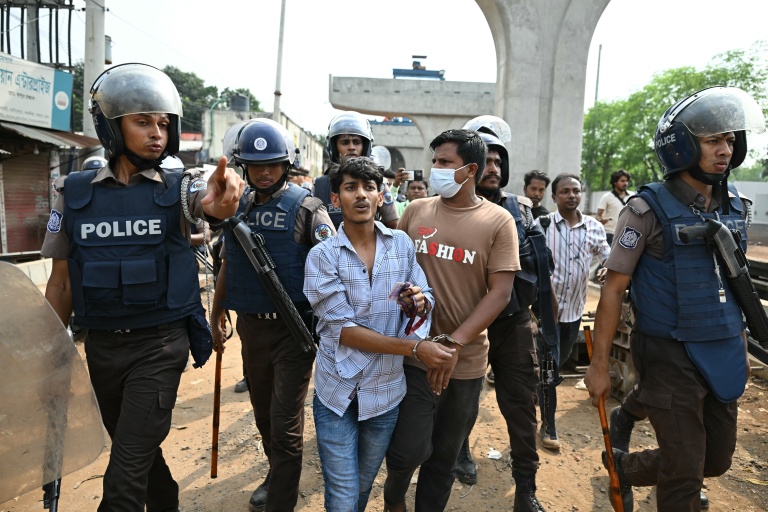
– Protests – Workers say rising costs of food, housing, transport, and healthcare have eroded their purchasing power, and are now demanding a minimum monthly wage of 30,000 taka ($245) — a 140 percent increase from the current 12,500 taka. The government on Sunday formed a six-member board to review pay, following negotiations with workers’ representatives and factory owners. Prime Minister Tarique Rahman instructed officials to “ensure workers’ rights and improve their living standards,” according to the government. Protests continue across industrial hubs, with workers blocking a major highway and clashing with police on Monday.
© 2024 AFP