

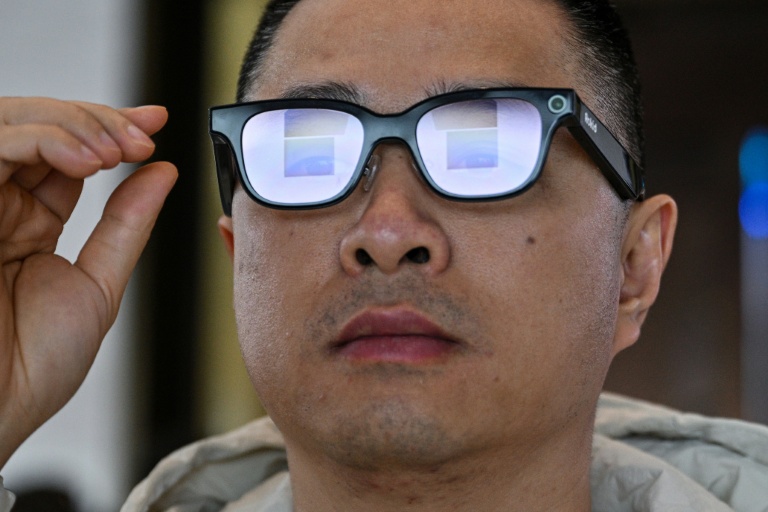
Hangzhou (China) (AFP) – In China, AI glasses let the wearer pay in shops with just a glance at a QR code and a voice command, as a growing number of companies look to conquer both growing domestic and overseas markets. Interest in smart eyewear is soaring worldwide after more than a decade of stalled promise, with advances in artificial intelligence sparking a fresh boon for the sector. US giant Meta is the clear market leader, but a host of Chinese companies — from behemoths like Alibaba and Xiaomi to start-ups like Rokid and XREAL — have their sights set on catching up.
“China’s advantages are self-evident,” Rokid CEO Misa Zhu told AFP after a recent launch in the eastern city of Hangzhou. “The ecosystem and its supply chain are all in China, and China produces a lot.” Domestically, Chinese companies have an undeniable edge — Meta’s services are blocked there, inaccessible without a VPN. The country is a potentially massive and lucrative market for wearable tech. Smart glasses sales are expected to have grown 116 percent there on-year in 2025, according to market intelligence provider IDC. Daily life is already highly digitalised, with even older citizens using smartphones for everything from payments to transport. China’s internet-based infrastructure, such as QR payment codes in shops, is “already more developed than in Europe and the United States,” said Zhu.
– ‘Dark horse’ Xiaomi – Other Chinese companies like Xiaomi, RayNeo, Thunderobot, and Kopin are active players in the smart glasses sector, wrote Flora Tang, an analyst at research firm Counterpoint. Xiaomi in particular was a “dark horse,” she said, its debut AI glasses the third best-selling of their kind for the first half of 2025 despite only being on sale for about a week. Interest is also being shown in smaller companies like Rokid, with the company raising more than $4 million on crowdfunding site Kickstarter recently. Rokid is “observing and learning…from big global companies,” CEO Zhu said. To straddle the domestic and overseas markets, the firm allows customers to use Chinese apps in China, and others elsewhere, unlike competitors like Meta, which limit the apps on offer.
The Rokid glasses are not locked to one generative AI model, either. “We are very open that we use OpenAI, and can also connect with Llama, Gemini, and Grok,” Zhu said. “That’s why many people like us.” Another feature Rokid demonstrated in Hangzhou was simultaneous translation, featuring phosphor-green English subtitles that rolled across the glasses’ inner lenses as an employee talked in Chinese. But shattering Meta’s dominance overseas will be challenging. In the first half of 2025, Meta commanded a 73 percent share of the growing global smart glasses market, according to Counterpoint. Its success has been attributed to the Ray-Ban Meta Smart Glasses, almost indistinguishable from everyday, and crucially fashionable, eyewear.
– Privacy concerns – In Hangzhou, Rokid unveiled new collaborations with Bolon, which is also owned by Ray-Ban’s parent company EssilorLuxottica. With weight also a crucial factor, Rokid says its models are among the world’s lightest. “Appearance remains the top priority — it has to make people actually want to wear it,” 25-year-old customer Wu Tianhao told AFP. Chinese firms showcase “numerous brands and models, rapid iteration, and ability to quickly adapt to market changes,” industry expert Zhu Dianrong said. However, “overseas brands still hold an advantage in hard tech like full-colour displays and optical waveguides.” Rokid’s vice president Gary Cai acknowledged an “obvious gap” in chip technology available in China and overseas, but noted the difference between AI models “has narrowed considerably.”
Despite interest in smart glasses rising, Chinese and foreign firms alike face major challenges ahead of widespread adoption. Across the board, the user experience needs more polish and accessibility, said Will Greenwald, writer for consumer electronics outlet PCMag. “I don’t think anyone has really made it a smooth experience just yet,” he told AFP. Privacy concerns remain a hurdle, with the ramifications of widely worn glasses discreetly and near-constantly recording throwing up potential regulatory pitfalls. Still, manufacturers such as Zhu remain confident. “Today, our AI glasses are phone peripherals,” he said. “But in the near future…phones will become accessories to the glasses.”
© 2024 AFP