
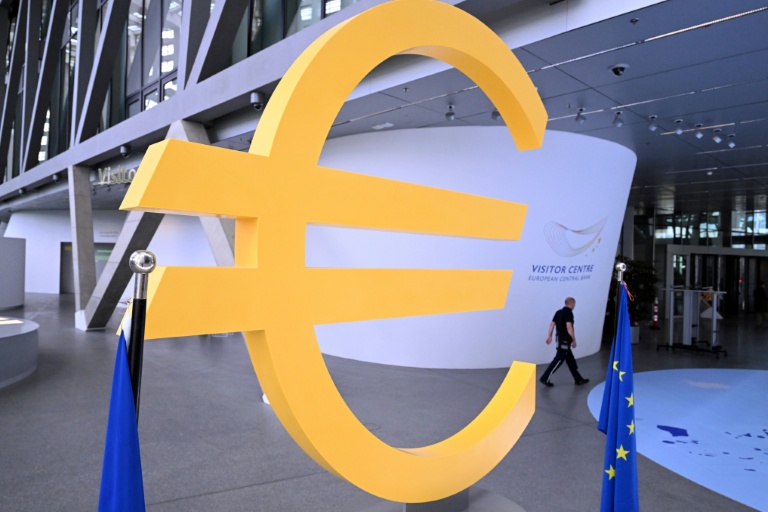
Frankfurt (Germany) (AFP) – The European Central Bank raised its benchmark interest rate Thursday for the first time since 2023 as the Middle East war stokes inflation, rejecting criticism that the move could hit growth in the struggling eurozone. The ECB lifted its deposit rate a quarter point to 2.25 percent, becoming the first major central bank to tighten monetary policy in response to the energy shock unleashed by the conflict. Eurozone inflation has been accelerating since the start of the US-Israeli war against Iran, jumping to 3.2 percent in May, above the ECB’s two-percent target.
President Christine Lagarde cited the “inflation pressures” generated by the conflict, as the ECB delivered its first rate hike since 2023. The decision was unanimous, she stressed, adding that it was a clear “signal and is necessary given the economic situation that we have, given the uncertainty that we are navigating, given the inflation outlook.” The central bank for the 21 countries that use the euro hiked its 2026 inflation forecast to three percent from a March estimate of 2.6 percent. With the Strait of Hormuz, a crucial oil and gas transit route, almost totally closed and a ceasefire in the three-month-old war looking shaky, Lagarde repeatedly stressed the conflict was a major source of “uncertainty.”
But she was also forced to defend the hike, which critics have said is not the right move at a time the single currency area is struggling on many fronts. “It’s not as if we are in an environment where growth is absent or under significant threat,” said Lagarde, in sometimes testy exchanges with reporters at a press conference. If inflation is allowed to get out of control, then “it becomes a much more difficult situation to bring it back to the level of price stability that we have defined,” she insisted. Lagarde also noted that the ECB had Thursday trimmed its 2026 growth forecast only slightly, by 0.1 percent to 0.8 percent. Some economists have said a rate hike— which aims to bring down inflation by suppressing demand— is not the right move to tackle a burst of inflation stemming mainly from a shortage of energy supplies. It comes with the euro area struggling to rebound from a long period in the doldrums, and as households and businesses battle higher energy costs from the Iran war.
As expected, Lagarde declined to give any indication of what the ECB might do later this year. But ING economist Carsten Brzeski said that Lagarde’s comments about inflationary pressures broadening hinted at further rate hikes to come. “A second rate hike after today’s decision, either in July or September, has become more likely,” he said. While some smaller central banks have lifted rates in response to the energy shock, other major institutions—including the US Federal Reserve and Bank of England—have held off as they assess the fallout. Both the Fed and BoE are due to hold meetings next week.
For the Frankfurt-based ECB, the rate increase is the first since policymakers were battling runaway inflation sparked by Russia’s invasion of Ukraine in 2022. Following that, the central bank delivered a series of cuts as inflation eased, but has held rates steady since June last year. Some analysts say the ECB move Thursday amounted to an “insurance hike,” as they were nervous about waiting too long to tighten monetary policy following criticism for being too slow to tame the inflation surge in 2022. But most say the economic backdrop now is different. Inflation was already elevated before the outbreak of the Ukraine war, and the global economy was struggling with post-pandemic supply chain woes. ING’s Brzeski said that, with Thursday’s move, the ECB appeared to be “fighting ghosts from the past.”
© 2024 AFP