
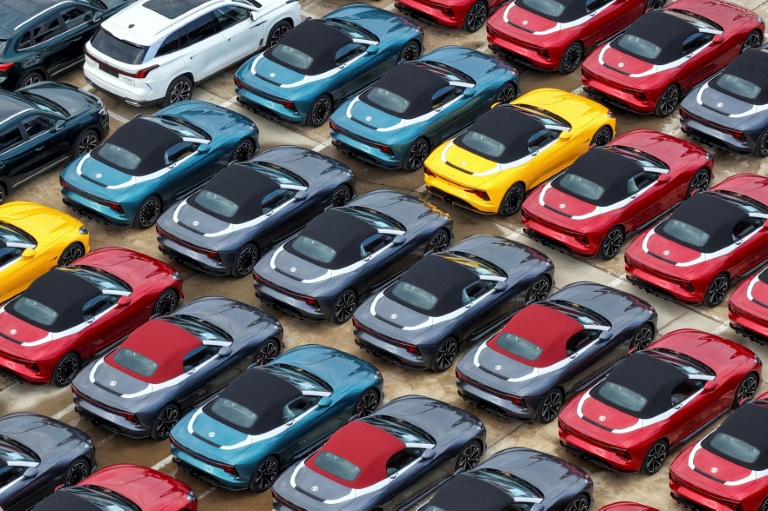
Brussels (Belgium) (AFP) – EU trade chief Maros Sefcovic will head to Beijing on Thursday for two days of make-or-break meetings with Chinese officials to try to stave off a trade war. The European Union has toughened its stance towards Beijing to defend businesses against what it believes is unfair competition in critical sectors including cars. Increasingly, European leaders and observers warn of a “China Shock 2.0,” which describes Chinese firms’ shift into more high-tech manufacturing, threatening many traditional EU industries. The first shock in the early 2000s saw a glut of cheap, low-tech exports from China that hurt manufacturers not just in Europe but around the world.
EU and Chinese officials have been locked in talks since June to address Brussels’ concerns about the current trade imbalance. The EU is simultaneously preparing to boost its trade defense toolbox, but Beijing has threatened to retaliate against any moves targeting China. Sefcovic raised the stakes for this week’s meetings in summer when he warned that the EU expected “tangible results by October” from the process. However, experts cautioned against expecting too much from this week’s meetings.
“There may be a few crumbs, but I would not expect any kind of major breakthrough,” Penny Naas, director of the Brussels office of the German Marshall Fund of the United States (GMF) think tank, said. There could be “agreements on some specific issues, rather than any broad settlement of the trade relationship,” said Zhu Tian, professor of economics at the China Europe International Business School (CEIBS) in Shanghai. It is clear Brussels is aware that the talks won’t solve all of its woes, with the commission working in parallel on new tools to protect European industries, which are expected to be presented to leaders in December.
What the EU wants is to cut its trade deficit with China, which hit around 360 billion euros in 2025, meaning the EU imported far more from the Asian nation than it exported there. China has a lower figure of around $292 billion but expects the deficit to rise further this year. The EU’s trade enforcement chief, Denis Redonnet, said sectors facing “sustained and abnormal” import increases included machinery, textiles, basic metals, and chemicals. There were “potentially worrying trends for almost a quarter of all imports into the EU at the moment,” driven mainly by Chinese goods, Redonnet told the European Parliament last week.
Sefcovic stated that the EU wanted to deliver on three main objectives, including tackling export surges from China to the bloc’s market, especially in critical sectors, and increasing exports from Europe to China. Brussels also wanted “a system of export licensing for rare earths and other products” after major producer China introduced restrictions on them last year. Europe hopes to manage Chinese exports through voluntary limits, for example on hybrid cars shipped to the bloc, but an EU official said Brussels wants to include other products. Beijing has firmly opposed import quotas.
China has limited room for maneuver due to weak domestic demand, meaning the government relies on exports to sustain growth levels. Since the bloc does not expect significant changes from China, the EU official, speaking on condition of anonymity, said it was also moving ahead with preparations for new tools. Several EU nations, including France, have pushed for a “European equivalent of Section 301,” the trade tool U.S. President Donald Trump used to probe foreign practices Washington deemed discriminatory and retaliate with tariffs.
Responding to reports last week about such a tool, Beijing warned it would “respond resolutely” to “discriminatory restrictive measures.” The EU knows these are not empty threats: China previously retaliated against the bloc’s trade defense moves with duties on European cognac and conducted anti-dumping probes into pork and dairy products. Brussels is also developing a tool to support businesses by funding efforts to diversify their suppliers in critical sectors.
It is still unclear, however, how far the EU as a whole would be willing to go against China for fear of provoking Beijing. Germany, particularly exposed since its biggest trading partner is China, has been especially cautious; however, Berlin’s stance has hardened as it worries that Chinese overcapacities are hurting its export-led economy. Europe has “the ability to do something more aggressive to stem this China 2.0 shock,” GMF’s Naas said. “The question is, will they?”
© 2024 AFP