
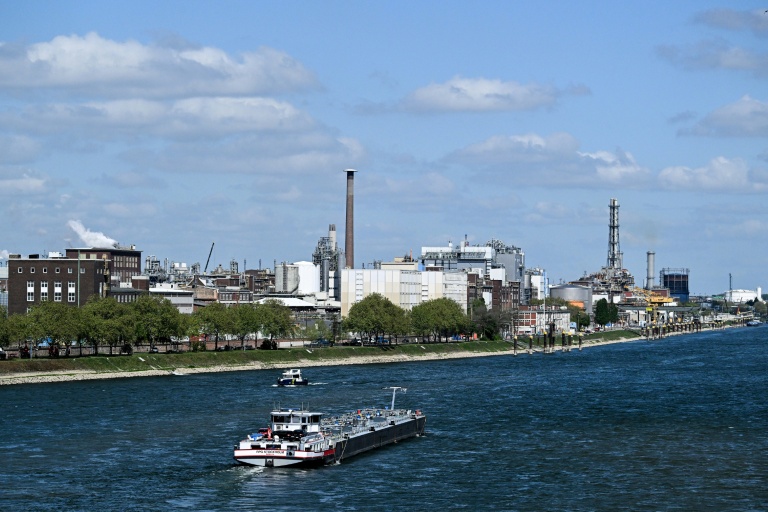
Ludwigshafen (Germany) (AFP) – Germany’s industrial decline is taking a painful toll on communities that have long relied on local manufacturing titans for jobs, prosperity, and a sense of a secure future. Among the places affected by the downturn is Ludwigshafen, a company town of chemical giant BASF, which has shed thousands of jobs while shifting its focus to China.
“The mood is obviously not good,” Sinischa Horvat, chairman of BASF’s works council, which represents staff interests, told AFP during a visit to the city of about 175,000 people. “The entire market is currently so weak. When you watch the news, you hardly hear any positive messages.” BASF is among Germany’s manufacturing heavyweights in sectors ranging from autos to steel and factory equipment that have been cutting back in their domestic markets. They are battling surging energy costs, fierce competition from China, and weak demand at a time when Europe’s biggest economy is mired in a long stagnation.
Some 2,500 jobs have been axed since 2022 in Ludwigshafen, which is dominated by sprawling chemical plants that stretch along the river Rhine, and more cuts are set to come. A recent decision to sell off thousands of company-owned apartments, many occupied by current and former workers, has added to unease. “The sale of these apartments sends a signal to the city and to the people who live here and, in some cases, work at BASF — BASF is scaling back its operations,” Patrick Thiel, who lives in one of the apartments and works at the firm, told AFP. “There is growing concern that this won’t stop at the apartments but will also affect the main plant,” added the 29-year-old, who also ran as a candidate in recent local polls for the far-left party Die Linke.
Horvat said having BASF staff in the properties helped create a “symbiosis” between the company and the community. “This has fostered an understanding of chemistry and shaped the relationship with BASF in the city,” he said. BASF — a supplier of base inputs to the agricultural, automotive, and pharmaceutical sectors — says the proceeds will go to bolstering its core businesses but acknowledged that the sale had “raised uncertainties”. A company spokeswoman, however, insisted that it would handle the sale responsibly, adding: “No one has to fear losing their home.” “We will continue to see ourselves as an integral part of the local community in the future,” she said.
Underlining its commitment to Ludwigshafen, where the group has over 30,000 employees — around a third of its global workforce — BASF has agreed to hold off on compulsory redundancies there until at least 2028 and continue investing. But as it cuts back at home, the world’s biggest chemical firm is investing heavily overseas, last month inaugurating a vast 8.7 billion euro ($10 billion) complex in China, its biggest ever single investment project. It insists that building up its presence in China, the world’s biggest chemical market, is crucial.
BASF is far from the only German company suffering. Last year, industrial companies cut 124,000 jobs, around double the figure in 2024, with hefty losses in particular found in the struggling auto sector, a study by consultancy EY showed. Germany’s manufacturing sector shrunk to a share of 19.5 percent of the country’s economy in 2025, according to official figures — its lowest level for many years. “The loss of industrial jobs in Germany has accelerated in the past two years,” Marcel Fratzscher, president of the DIW economic institute, told AFP. “Companies that used to be the pride of Germany are suffering.”
Areas that have already suffered industrial job losses see greater social problems and offer fertile ground for fringe parties, such as the far-right Alternative for Germany (AfD), to pick up support, experts warn. Still, Fratzscher said that Germany had undergone economic upheavals before and urged politicians and companies to try to ensure the economy emerges stronger. The current economic transformation should be seen “as an opportunity to move into sectors that have better margins, better jobs,” he said. “The biggest mistake we can make is to try to cement the status quo, to keep all companies exactly the same. That would lead to a much bigger deindustrialisation.”
© 2024 AFP