
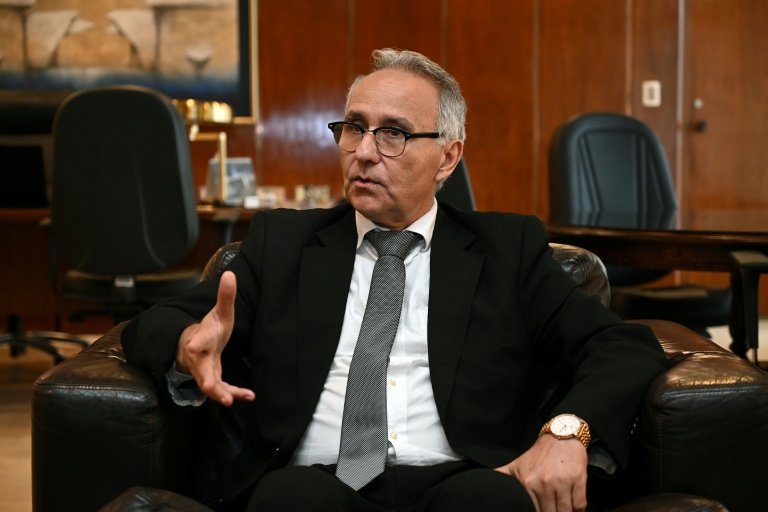
Asuncion (Paraguay) (AFP) – The new president of the Central Bank of Paraguay (BCP) estimated in an interview with AFP on Wednesday that the irrecuperable losses from the collapse of Ueno Bank could reach up to $1 billion in the worst-case scenario. Jorge Luis Schreiner — who became the BCP head after his predecessor was arrested in connection to the crisis, alongside former president Santiago Pena — believes at least some of the money will be recovered. But for him, “it was not a financial crisis, but the crisis of a bank.” He believes the collapse originated in loans that Ueno granted that were above the legal limit to businesses in its own group and with ties to those in political office.
Q: Where do things stand with returning money to depositors?
A: “The Central Bank, thank God, had such a quick reaction that in less than five days it transferred accounts for some 1,812,000 people. That is a record. I received many congratulations from Brazil and other neighboring countries…despite institutional weaknesses, the country reacted in time.”
“We are talking about two decades of effort by the banking system to accumulate funds for more than $1.6 billion, of which $700 million were used to honor up to 40 minimum wages…we’re talking about approximately $18,000.”
“I cannot promise magic, but I can promise that by December we will have fully transferred both the loan portfolio and the card portfolio.”
Q: How much do you estimate the losses from the Ueno Bank collapse to be, and how much of it is unrecoverable?
A: “We’re going to assume the worst-case scenario that those assets which today are considered to be worth nothing are actually worth nothing. The first negative amount would be the $700 million from the guarantor fund, which must be newly recuperated in a reasonable time frame.”
“The other is bonds issued outside the country that are not protected by the law…the sum of that could reach $1 billion or a little more.”
“But I don’t want to be irresponsible, because it will take at least one or two months to determine exactly the market value of each asset. Now we are calculating what would be its value on paper, and then comes the stage of how much the market is willing to pay for that asset. There are very valuable properties.”
Q: You said there’s been $600 million identified in transferable assets that could cover pension funds. How much have you identified so far?
A: “Today we’re already at a little more than $1 billion.”
Q: What lessons did the crisis teach?
A: “I would recommend to the region that we learn that any link between business groups or banks with the government is not conducive to an image of transparency and good management.”
Q: How do you restore confidence in the Central Bank and its independence from politics after this crisis?
A: “My first wish and condition to the current president, (Pedro) Alliana, is total support without political interference. That is my condition.”
“That is why in recent days I requested technical assistance from the International Monetary Fund (IMF) to review any elements we’re missing to reinforce the Central Bank…And today we have the beautiful opportunity to rebuild this, reviewing regulations that were intentionally modified in order to weaken independence.”
Q: What are the next steps?
A: “First off, in December the first mission (of the IMF) would come to agree on a trajectory, what kind of laws do we need to review, which operational aspects of the Central Bank do we need to revise, including is foreign currency exchange and monetary policy. I requested a full review in order to discuss with the new board what needs to change at the Central Bank.”
© 2024 AFP