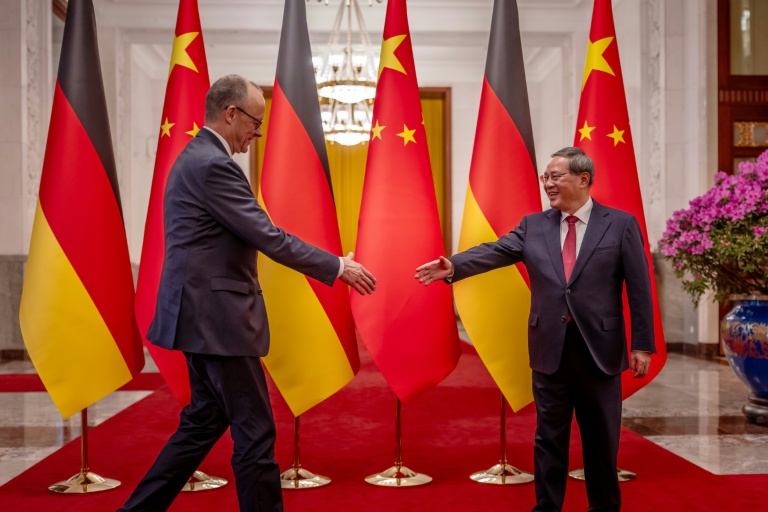

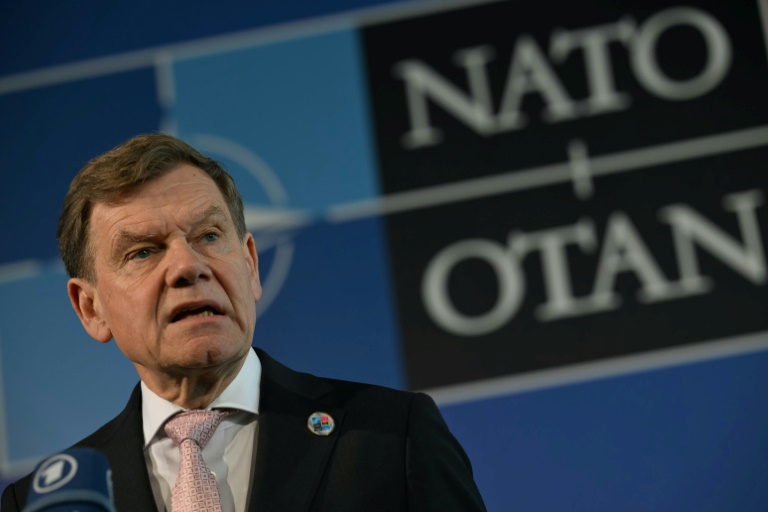
Berlin (AFP) – Germany’s new government surprised NATO allies on Thursday by putting forward plans to boost defence spending, to meet a target of five percent of GDP demanded by US President Donald Trump. Foreign Minister Johann Wadephul made the pledge a day after German Chancellor Friedrich Merz, in office for just over a week, said his coalition government intends to have “the strongest conventional army in Europe”.
NATO chief Mark Rutte has floated a plan for members to hit the five-percent goal by spending 3.5 percent of GDP on military spending and 1.5 percent on other security measures such as infrastructure and cyber defence. Wadephul, speaking at a NATO meeting in Turkey, pointed to Rutte’s proposal to reach “the five percent that President Trump demanded” and declared that “we follow him there”.
In Berlin, Finance Minister Lars Klingbeil struck a more cautious note, saying that “we will spend more on security, but how much that will be we will see in the agreement reached at the NATO summit” to take place next month in The Hague. Roderich Kiesewetter, a former senior German military officer and a politician in Merz’s CDU party, called the announced move a “paradigm shift” in an interview with the Bild daily. He added that “it won’t happen overnight, but it has to happen”.
The goal sounds ambitious, given the dire state of the German armed forces which have been plagued by shortages of key weapons systems and face trouble recruiting new troops. Germany, with its dark World War II history, has long been reluctant to spend big on defence. Funding dropped off sharply after the Cold War as European countries relied on NATO heavyweight the United States for security. Decades of lower military spending has reduced Germany’s number of battle tanks and howitzers from the thousands to the hundreds.
In recent years, Germany’s armed forces were mocked for equipment failures when they deployed in Afghanistan and Mali. Those included helicopters that couldn’t fly and rifles that did not shoot straight. The army, hoping to boost troop strength to 203,000 by 2031, fell short of its incremental target last year by more than 20,000, despite a social media campaign. The military has “too little of everything” — from air defences and drones to satellites and AI capabilities — the parliamentary commissioner for the armed forces, Eva Hoegl, warned in March.
Trump has long claimed NATO partners are not paying their fair share. Germany only just hit the alliance’s target last year of spending two percent of GDP on defence. Russia’s 2022 invasion of Ukraine led then-chancellor Olaf Scholz to announce 100 billion euros ($110 billion) in extra defence spending. Major orders placed include new submarines and F-35 fighter jets — but they will take years to be delivered.
Now Merz has signalled an even bigger shift, warning of the threat from a hostile Russia. For Germany, spending five percent of GDP would equate to more than 200 billion euros per year — a figure previously deemed unrealistic. But Merz’s coalition has secured major financial firepower: an easing of debt rules and approval for hundreds of billions in extra funding for defence and infrastructure.
Merz told Die Zeit weekly that spending big on defence — especially for European-made systems — should be seen as a stimulus for the recession-hit economy. “If we want to strengthen our defence capabilities, we must gradually reduce our dependence on the US,” he said. The CEO of German defence giant Rheinmetall, Armin Papperger, said that, after stepping up capacity in recent years, “we can deliver”.
A lawmaker with the far-right Alternative for Germany (AfD) that embraces Moscow-friendly policies, Peter Boehringer, called the five-percent target “completely absurd”. Criticism also came from Ralf Stegner of the SPD, the junior coalition partner in Merz’s government. Stegner told the Handelsblatt daily that, in a conflict-torn world, “disarmament is the order of the day…not an arms race”. Spending “billions on weapons that reduce the world to rubble and ashes and then billions for the reconstruction of Gaza, Ukraine and Aleppo, that is collective madness,” he said.
© 2024 AFP