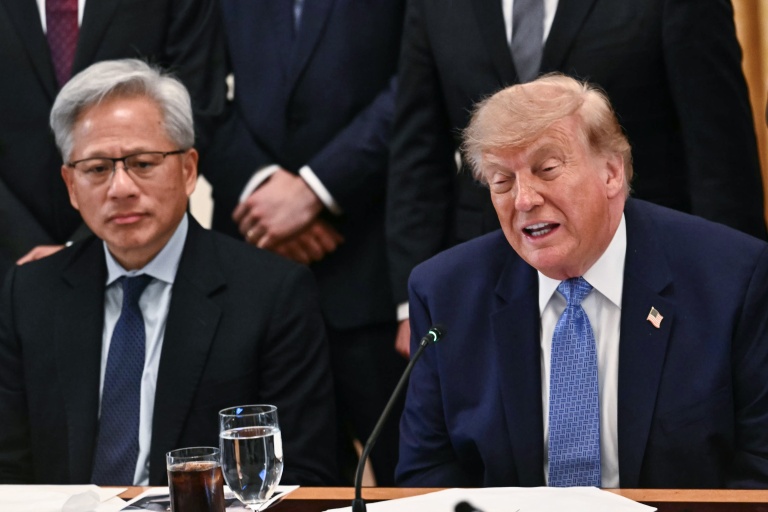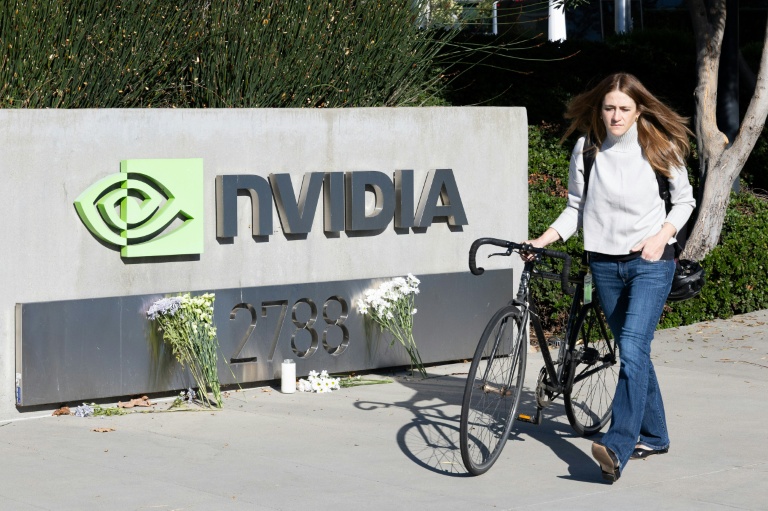

Washington (United States) (AFP) – It was personal and it was public. US President Donald Trump’s push for Jensen Huang’s reinstatement as the head of Nvidia was an intervention in the business world like no American president has done before. “There’s no precedent for any of this,” Ann Lipton, a law professor at the University of Colorado Boulder, told AFP.
According to media reports, the 80-year-old billionaire invited himself onto a conference call of Nvidia’s board to plead the case of the chip giant’s founder, who was ousted after revelations about his affair with a woman suspected of spying for Beijing. Trump assured board members that Huang would face no action from the Justice Department — a promise he could make, as the department is headed by his former personal lawyer.
The unprecedented move breaks with the long-held American tradition of free enterprise, which rejects government intervention outright — or at least overly explicit state direction of the economy. At the height of the financial crisis in 2009, the White House secured the departure of the head of General Motors, a carmaker then being kept afloat by government aid, but President Barack Obama did not boast about it. The Nvidia case is very different. For one thing, the government has no financial ties to the thriving company.
Trump also publicly demanded Huang’s return, openly celebrated it and, above all, acknowledged having pressured the company “directly.” Since returning to the White House, the president has pursued an aggressive industrial policy driven by strategic considerations, but also by his personal impulses and an obsession with the stock market’s performance. At his request, for example, the US government acquired roughly 10 percent of technology giant Intel, along with minority stakes in several technology companies.
Trump decides “the companies that he favors,” Lipton said, and that is “contrary to how capitalism is supposed to operate.” Nvidia reportedly donated $25 million toward the construction of a White House ballroom, a project particularly dear to the president. “When somebody is nice to me, I love that person,” Trump, who is known for his candor, said in the Spring. “Even if they’re bad people I couldn’t care less.”
Trump also intervened in the Nvidia affair to halt a plunge in artificial intelligence stocks triggered by Huang’s ouster, which had raised fears of a broader stock market correction. Nvidia shares jumped more than 31 percent Monday. “That really shows the decision was right,” Trump told the Wall Street Journal.
According to the Financial Times, the former property developer himself benefited, with the value of his personal stake in Nvidia rising by $15 million. The White House has repeatedly stressed that Trump does not manage his own stock portfolio and insists there are no grounds to suspect him of insider trading.
Beyond the financial considerations, some of the president’s opponents point to his distrust of the national security apparatus, which he views as a kind of shadow government, or “deep state,” working against him. That distrust may have led him to ignore or downplay warnings about the company’s ties to China. “This goes back to his political origin story, and his anger over undisputed intel that Russia had meddled on his behalf in the 2016 election,” prominent Democratic strategist David Axelrod wrote on X.
In an interview with CNBC, Trump indicated that he would not rule out intervening again in the affairs of major companies if he deemed it necessary. But where was the line? Which companies deserved intervention and which did not? “I can only say it’s touch, it’s feel,” Trump said.
© 2024 AFP