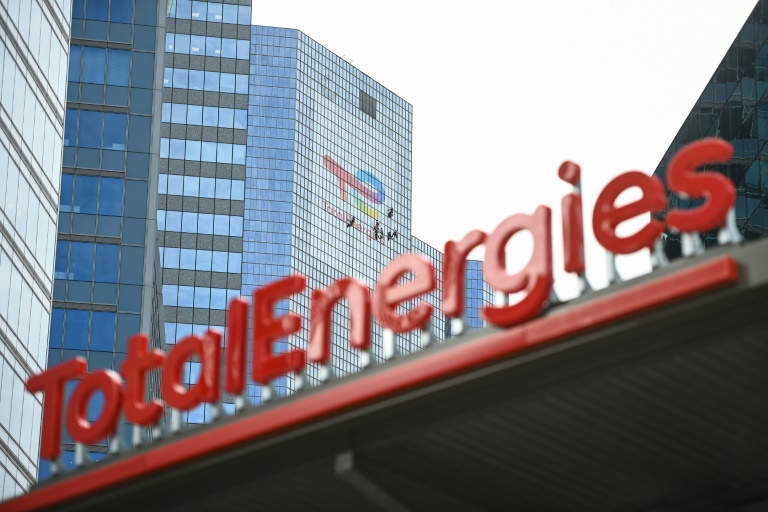

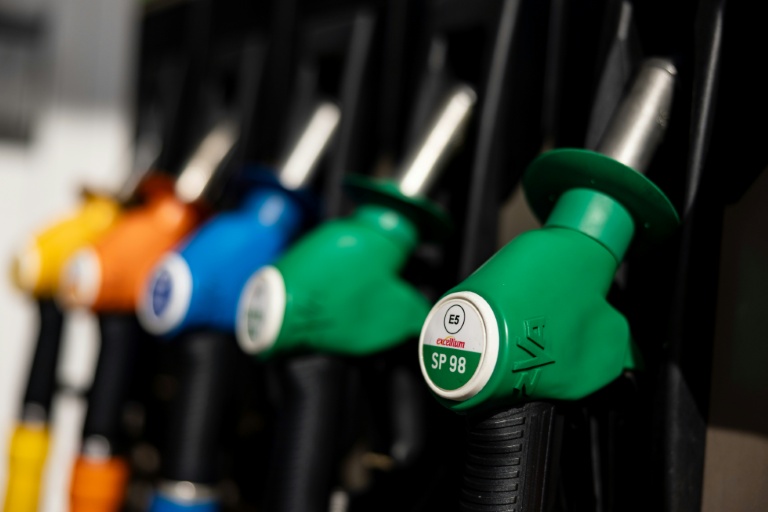
Paris (France) (AFP) – French motorists are clogging TotalEnergies service stations to fill up with discount gasoline, but its rivals are crying foul, accusing the energy giant of distorting competition with the encouragement of the government.
TotalEnergies, which pumps crude oil and refines it into gasoline, has an extensive network of filling stations throughout France, where retail sales are usually dominated by supermarkets selling gasoline at or near cost to attract customers. However, as oil prices surged this spring due to the US-Iran war, the highly profitable company announced a cap of 1.99 euros per litre ($2.29 per litre, roughly $8.70 per US gallon), considerably less than the national average of around 2.15 euros per litre — and up to nearly 2.50 euros in other areas, including Paris. The cap, which has been in place intermittently for the past five months, has already cost the company between 250 million and 300 million euros. While it is a hefty expense, higher oil prices helped the French company double its first-half profit to 11.2 billion euros.
TotalEnergies introduced the cap when political pressure was mounting to implement a tax on the windfall profits being made by energy companies. Prime Minister Sebastien Lecornu called on the company in May to establish “a generous cap.” Its chief executive, Patrick Pouyanne, has made it clear that the company will abandon the cap if a special tax is instituted. “There’s nothing forcing us” to keep the cap in place, Pouyanne said recently. “If a tax is introduced, we’ll draw our conclusions, and TotalEnergies won’t have any more price caps,” he added.
With a presidential election seven months away and France’s economic situation worsening, the government is keeping a close watch. “Today, the public authorities are quite happy a private company is doing the job, perhaps in their place,” said Jacques Goisque, head of the FF3C trade association that represents a thousand independent service stations. However, there are limits to how much relief TotalEnergies can provide. The most recent jump in fuel prices has prompted calls for demonstrations reminiscent of the so-called yellow vest movement in 2018. At that time, a plan to increase fuel taxes sparked widespread protests from low- and middle-income workers who stood to take the biggest financial hit, which snowballed into a challenge to the economic policies of President Emmanuel Macron.
Macron called on Wednesday for the government to address the issues surrounding fuel supplies and prices. Government spokeswoman Maud Bregeon noted that around one in ten filling stations in France lacked at least one fuel, with the vast majority of them being TotalEnergies stations. She stated that the government would seek to ensure sufficient supplies and gain some regulatory flexibility concerning refineries. The goal is “to push prices down as much as possible, or at the very least to keep their increase under control,” she said.
The FF3C group of independent petrol stations lodged a complaint in mid-July with France’s competition regulator for unfair competition. “There is an upstream player with a dominant position that takes advantage of it to set very aggressive prices that are below market levels,” the FF3C’s Goisque told AFP. “We can’t sell at a loss.” The supermarkets that usually sell gasoline at a loss leader to attract customers are also furious. Michel-Edouard Leclerc, head of the leading supermarket chain E.Leclerc, stated, “Refiners are lining their pockets,” while it is impossible for retail distributors to compete. “We can’t go any lower than what our prices are today,” he said. “We don’t have a cent of margin in our filling stations.”
More than a dozen filling stations closed over the past weekend on the island of Corsica. “Despite the efforts of our supplier, our purchase price exceeds Total’s retail price by several dozen cents,” the stations said in a statement. They condemned “the state failing to regulate prices,” which “allows an integrated group that benefits from considerable upstream margins to dictate, to blackmail, leading to this distortion of competition.”
While the price cap has financial costs for TotalEnergies, it has significantly benefited the company’s public image, particularly in light of frequent criticism regarding the low amount of taxes it pays in France compared to its global profits. The price cap has “above all earned the company a large amount of goodwill among the French,” Pouyanne, the chief executive, said recently.
© 2024 AFP