
Berlin (AFP) – Airbus and seven other companies are set to launch a consortium to build a next-generation fighter jet in Berlin on Thursday, hoping to replace the Franco-German FCAS project that was scrapped this week.
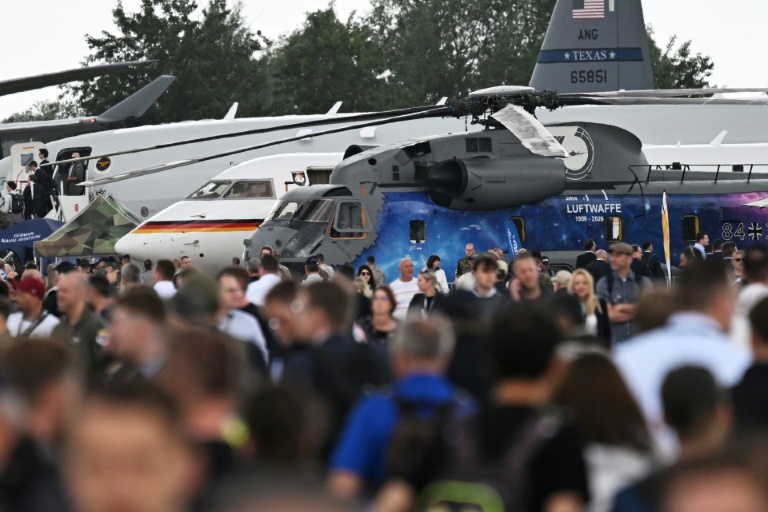
“We are ready to assume responsibility,” the head of Airbus’s defence division, Michael Schoellhorn, said about the plans on Wednesday as he welcomed Chancellor Friedrich Merz to the International Aerospace Exhibition (ILA). The eight-company alliance — made of mostly German corporate players and dubbed “Team Gen 6” — plans to hold a signing ceremony at the airshow on Thursday, Airbus told AFP. Schoellhorn vowed that “we have the expertise, the technologies, the capacity and the clear determination” to build the sixth-generation fighter jet.
In addition to Airbus, the alliance includes the European missile manufacturer MBDA and six German firms: Hensoldt, Diehl Defence, MTU Aero Engines, Liebherr, Autoflug, and Rohde & Schwarz. The long troubled Future Combat Air System (FCAS) programme was abandoned on Monday by Berlin and Paris after months of tension between the two main manufacturers, Airbus and France’s Dassault. The collapse of FCAS, which also involved Spain, comes at a time Europe is rushing to build up its defences against a hostile Russia and amid strained defence ties with NATO partner the United States under President Donald Trump.
Merz said that cancelling FCAS “clears a long-standing obstacle” and also “opens up new opportunities for the industry to make further progress in the development of modern fighter aircraft by exploring alternative approaches.” The chancellor said that “core aspects” of the FCAS programme — an integrated digital system aimed at linking the fighter jet to drones, sensors, and other technology — will continue.
Berlin has not yet committed to an alternative fighter jet project to FCAS, with a government spokesman on Wednesday saying only that “as one door closes, others open.” Schoellhorn rejected the idea that Germany would be moving away from European cooperation if it backs the Airbus-led proposal. “We are not advocating for Germany to go it alone,” Schoellhorn said. “We think in European terms, but we want to see German industry playing a significant and responsible role.”
The eight companies have already sent a position paper to German Defence Minister Boris Pistorius outlining their vision for the new jet. Their joint paper, seen by AFP, calls on Berlin to ensure “a complete and timely awarding of contracts by the second half of 2026.” FCAS, launched in 2017 by France and Germany and joined by Spain in 2019, had been considered a flagship project of European defence cooperation. The multi-billion-euro project aimed not only to build an advanced warplane but also create an integrated array of unmanned drones and a sophisticated combat computer system to link the pieces.
Pistorius told reporters on Tuesday that the eight-company project “is conceivable and one possibility.” But he added that Germany is also weighing other options, such as purchasing more American F-35 fighter jets or joining other ongoing aircraft development projects. Other potential partners could in theory include Sweden’s Saab or a group of firms from Britain, Italy, and Japan that are also working on a new fighter jet.
The FCAS programme was intended to eventually replace France’s Rafale jets and the Eurofighter planes used by Germany and Spain, with the first planes expected to enter service around 2040. But long-simmering problems came to a head in mid-2025, as Dassault made an aggressive push to take greater control of the programme. That rankled politicians in Berlin and executives at Airbus, who feared being squeezed out of contracts. Sharply different requirements for the French and German military had also complicated the project.
© 2024 AFP