
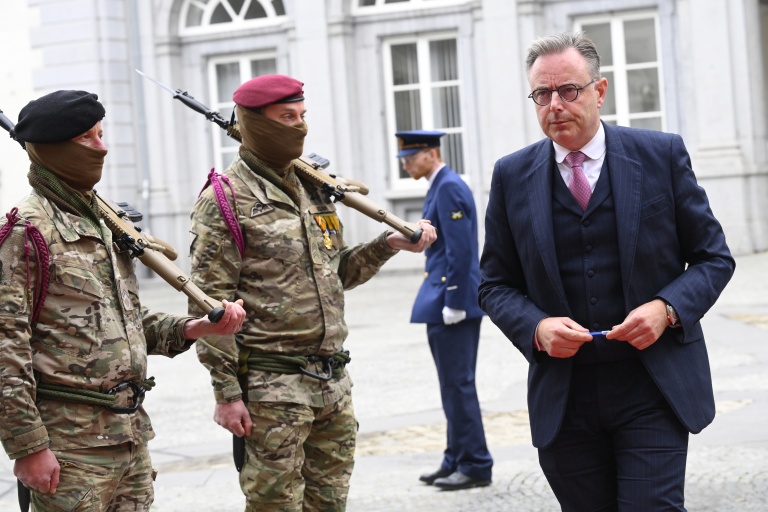
Brussels (Belgium) (AFP) – Belgian Prime Minister Bart De Wever tendered his resignation to King Philippe on Monday as coalition talks deadlocked over a deficit-cutting budget, with the monarch putting off his decision until the end of the week.
The Flemish conservative has been locked in protracted coalition talks to agree on a federal budget for next year, with the government seeking 10 billion euros ($11.6 billion) in savings by 2029 to reduce the country’s high deficit. The latest talks broke down hours before De Wever put forward his resignation.
“The king is withholding his decision and will launch discussions tomorrow with the different party leaders of the governing coalition,” said a royal statement, adding that De Wever would be received again on Friday. Belgium “cannot afford a prolonged political crisis,” the palace warned in a statement, adding that “The king regrets the lack of agreement to give the country a credible budget that meets the current challenges.” “The king therefore calls on everyone to show a sense of responsibility and urges all parties involved to put the general interest and the spirit of compromise first,” it said.
De Wever, whose New Flemish Alliance (N-VA) has led a five-party centre-right coalition since February 2025, did not immediately comment. Instead, it was left to the Instagram account of his cat Maximus, reportedly the second most popular political account on Belgian social media after De Wever’s, to opine that “there are days like that.” A similar budget impasse occurred a year ago, when De Wever nearly tendered his resignation to the king.
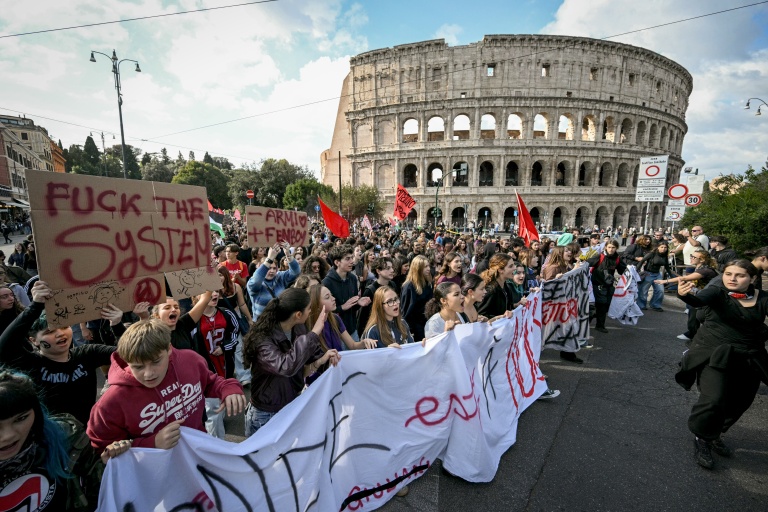
The government is seeking savings and new revenue to help cut a budget deficit that exceeds five percent of Belgium’s GDP. Its plan relies mainly on cuts to public spending, including on healthcare, but also includes a VAT increase that is strongly opposed by one coalition partner. That partner, the French-speaking liberal MR party, says tax hikes would fuel inflation. Recent months have seen trade unions mobilize against austerity measures with rolling protests that have brought tens of thousands of people into the streets. One, on October 9, culminated in violence and vandalism.
– Deadlock –
The outlook for reviving the deadlocked talks remains bleak. David Clarinval, an MR member who is also the economy minister, warned that “the level of taxation under discussion remains far too high and far exceeds what was set out in the coalition agreement.” “Refusing to implement genuine reforms to reduce public spending condemns the country to an ever-widening deficit,” he added.
Flemish-speaking Christian Democrats within the coalition urged urgent talks, while French-speaking counterparts Les Engages called for an “equitable solution” to ensure that those with “the broadest shoulders” made a fair contribution. In opposition ranks, meanwhile, Francophone socialists accused the government of trying to “protect, whatever the cost, those with the largest fortunes to the detriment of the rest of the population.” And the far-right Vlaams Belang accused the government of presiding over a “historic budgetary crisis.” The country’s main employers’ organisation, quoted by the Belga news agency, warned meanwhile of the dangers of a political crisis when “markets are paying increasingly close attention to Belgium.” adc/cw/ec/js
© 2024 AFP