
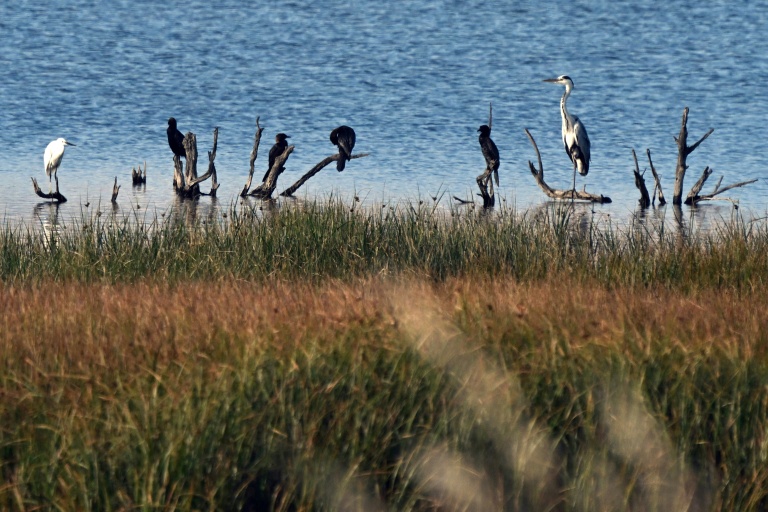
Ulcinj (Montenegro) (AFP) – Every year, tens of thousands of birds glide over the rusting remains of one of the Mediterranean’s largest saltworks, to rest in the rare paradise it left behind. But experts warn the sprawling salt flats of Montenegro’s Ulcinj salina, a vital stop-off for migrating flamingos, pelicans and other species, is fading fast. The salt company closed 13 years ago, and since then, environmental activists and former employees have pushed for the return of production to revitalise both the local economy and a key habitat that relied on industrial-scale saltwater pumping.
“If we wait, probably in three years, we will not have this landscape as we see it today,” environmental activist Zenepa Lika told AFP as she stood above the overgrown channels which crisscross the site. Salt production began in Ulcinj almost a century ago when the natural lagoon was transformed into a network of shallow evaporating basins. The unique conditions the process demanded — pumping saltwater in and out to maintain a shallow depth — were also the perfect environment for hungry wading birds.
As the industry boomed, birds migrating to and from Africa along one of Europe’s key flyways were increasingly drawn to the area; today it is internationally recognised as a vital wetland. But when the salt company shuttered in 2013, the pumping that maintained the basins stopped, endangering the environment the birds have come to rely on. “We don’t have time because every year that we are not working and we are not repairing the site, we are losing biodiversity,” Lika, from the Dr Martin Schneider Jacoby Association which advocates for the salina, said.
Mountains of salt – For locals, the saltworks had also been a source of pride, a large employer and a rare example of industry co-existing with nature. It survived the disintegration of Yugoslavia in the 90s but collapsed when the company responsible for the site declared bankruptcy amid allegations of mismanagement. “I remember that as a child I climbed up there, all the way to the main roof tile,” former salt farmer Omer Hot said, gesturing at the seven-metre-high storehouse roof. A dirty grey mound is all that remains of the salt mountains that once filled the building, now a weathered steel skeleton. “I cannot describe it. I mean, it looks ugly, really ugly,” the 69-year-old said, peering through its corroding gates.
A shifting landscape – But beyond the crumbling infrastructure lies a bird haven. According to experts, the salina hosts more than one percent of the global populations of at least seven bird species. Despite developers eyeing the prime real estate on the country’s tourist coast, activists like Lika successfully pushed to protect the site, which is over four times the size of New York’s Central Park. In 2019, it was recognised as an internationally important wetland under the Ramsar treaty — designed to protect key habitats around the world. But official recognition as a protected area changed little on the ground, according to Lika.
“The crystallisation basins are covered by grass and sheath and so on. This is not the landscape that usually salinas are,” she said, explaining the changes to the area that saltwork pumping created. Earlier this year, Montenegro’s government and the Ulcinj municipality announced a four-million-euro ($4.6 million) joint venture to run the area as a nature reserve and restart salt production. The Balkan nation has even pinned part of its bid to join the European Union on reviving the site — with environmental benchmarks required for membership closely tied to the salina’s health.
‘Constant delay and aimless stumbling’ – But local journalist Mustafa Canka, who has tracked the project for years, said previous estimates put the cost of restarting the salt industry and preserving the salina at almost five times the earmarked amount. “The decision-makers now know practically everything there is to know about the saltworks,” the 57-year-old said, referring to the numerous studies and plans discussed by governments over the years. “The only question is who will pay for production to restart,” he said. The “constant delay and aimless stumbling” around the project had made any planned recovery even more “painful, slow and difficult,” as the town’s experienced salt workers were now long retired or dead, he said. “We need to draw on the knowledge of the people who once worked here, those who understand how the saltwork breathes,” he said. Neither the local nor the national government responded to AFP’s request for comment regarding the salina’s management.
As Lika watched black-winged stilts stalk through reeds in the shimmering sunset, she said the loss of what locals call “Heathrow” for birds, due to its stream of arrivals and departures, would impact well beyond Montenegro. “If we don’t work more seriously on the rehabilitation of this site, then we are going to lose one of the most important areas in Europe.”
© 2024 AFP