
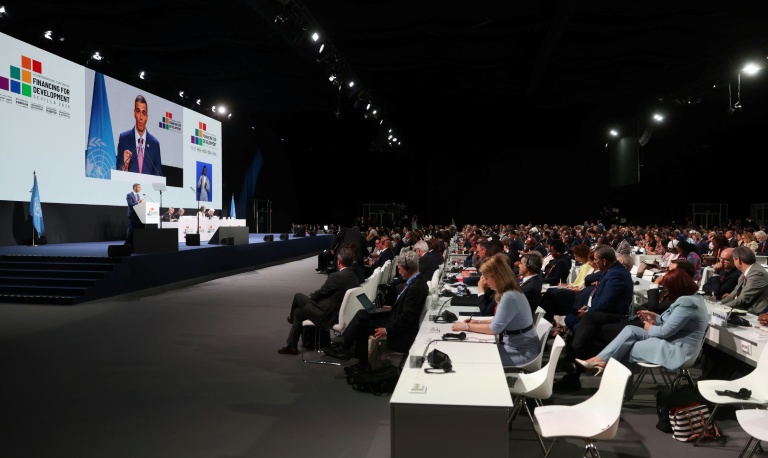
Seville (Spain) (AFP) – As cuts by rich donors decimate aid budgets for the world’s most vulnerable, private financing has been touted as the sector’s saviour — but not everyone is convinced. The United Nations puts the annual funding deficit for aid at more than $4 trillion, with chilling consequences for health, education, and humanitarian programmes in the poorest countries. The yawning gap left by traditional aid sources such as governments, development banks, and philanthropy thrusts private investment into the spotlight at a UN aid conference in Spain this week.
“We need the private sector and the jobs it creates because jobs are the surest way to put a nail in the coffin of poverty,” World Bank chief Ajay Banga told attendees at the event in Seville. Banga said the private sector could succeed with the “right conditions,” including infrastructure, transparent laws and institutions, and an environment favourable for business. The document adopted in Seville, which will frame future development cooperation, pledges to generate funds “from all sources, recognising the comparative advantages of public and private finance.”
Private resources appeal to developing nations as “a more sustainable source of finance that doesn’t lead to debt spirals and dependency on external resources,” said Laura Carvalho, an economics professor at the University of Sao Paulo. But they have so far failed to deliver at the scale required and are “perceived as a way to deviate from commitment” for rich nations, with many pledges becoming “fictional,” she told AFP. The UN Development Programme said tapping into potentially trillions of dollars of private capital had a role to play for development finance alongside traditional external aid and increased domestic resources, notably taxation.
“We have a lot of private capital…not all aligned to national development priorities. They are primarily motivated by profit,” the agency’s head Haoliang Xu told AFP. According to a report by the Organisation for Economic Cooperation and Development (OECD), only 12 percent of private finance mobilised from 2018 to 2020 went to projects in low-income countries. These are typically viewed as riskier investments with costlier interest on their loans, compounding their debt burden.
Campaigners have criticised rich countries for pushing private finance over public sources of aid, citing a lack of accountability and debt issues. International charity Oxfam said private creditors accounted for more than half of the debt of low- and middle-income countries, exacerbating the crisis “with their refusal to negotiate and their punitive terms.” “Wealthy Global North investors’ ambitions have been whitewashed under the guise of financing development,” whereas there was “no substitute” for foreign aid, Oxfam wrote in a statement.
For Rebecca Thissen, global advocacy lead at Climate Action Network International, rich countries must stop “clinging to the false hope that the private sector alone can fill the gap” in climate finance. Grant-based public finance is instead necessary for helping poor nations respond to the devastating impact of fiercer storms, floods, and droughts, which set back their development and for which they are least responsible, she said. “Public international finance remains indispensable,” Kenya’s President William Ruto said Monday, urging the United States — which snubbed the Seville talks — to reconsider its disengagement from foreign aid under President Donald Trump.
With the OECD forecasting that official development assistance could fall by up to 17 percent this year, the focus is also on increasing public resources in low-income nations. The language on this topic, which highlights taxation, national development banks, and clamping down on tax evasion, is a “big win” in the Seville document, said Carvalho, who is also director of economic and climate prosperity at Open Society Foundations. Even before the recent aid cuts, net flows of resources were moving from the Global South to the North through illicit financial networks, tax evasion, multinationals, and debt servicing, she said. “There is an opportunity to reform the system in a way that helps countries raise their own resources, as opposed to relying on external loans,” Carvalho said.
© 2024 AFP